Sarah McLean
,
Lead Content Manager
Author
, Published on
March 23, 2026
No items found.



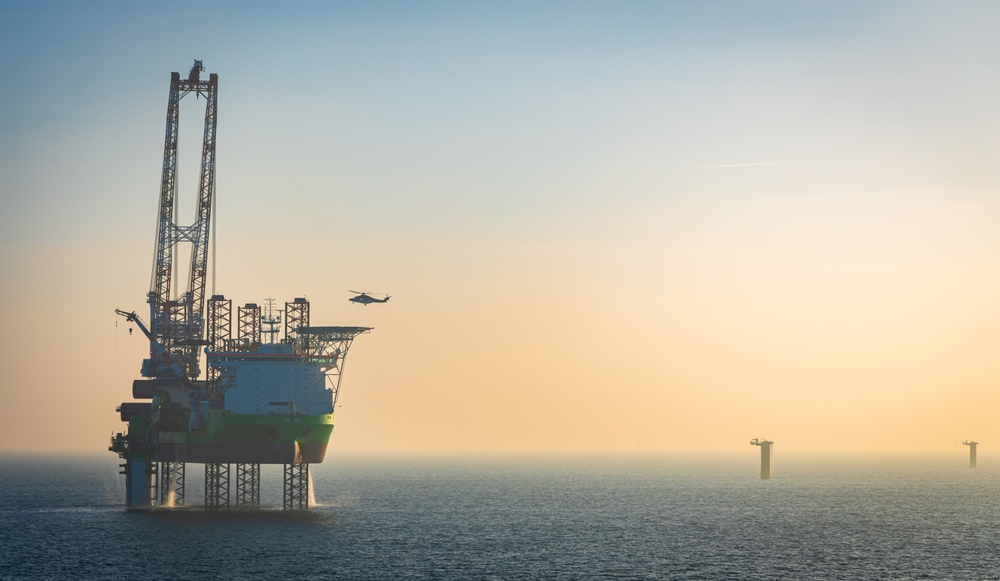
Installation works at EDF’s Saint-Nazaire wind farm drew to a close on September 5 as WTIV Vole Au Vent installed the last of the 80 wind turbines that make up France’s first offshore wind farm.

SpinConstruction analytics indicates that Vole Au Vent (delivered in 2013) spent a total of 158.4 days working on the Saint-Nazaire wind farm. It began the charter in late March 2022 and, overall, the vessel averaged four installations per trip. Forward plans for the vessel include two Vattenfall scopes in 2023 for turbine installation at Vesterhav Syd and Vesterhav Nord offshore Denmark.
The 480 MW Saint-Nazaire project, which is located between 12 and 20 km off the Atlantic coast, has an overall surface area of 78 km². The wind turbines selected for the project are GE Haliade 150-6 turbines (6 MW) on monopile foundations.
The project delivered its first power on June 9, 2022, and is slated to be fully commissioned by 2023.
Saint-Nazaire is the first of many fixed-bottom offshore wind farms being built in French waters. Other projects include Saint Brieuc (~500 MW), Fecamp (~500 MW), and Calvados (~450 MW) - all of which are expected to come online before 2025.
Read More: World’s largest semi-submersible crane vessel in operation at Fécamp

The French government has plans to develop 5 GW of offshore wind capacity by 2028 and 40 GW, spread across 50 wind farms, by 2050. These ambitious plans are driven by a need to speed up the transition to energy autonomy in France and an increased push to move to renewable energy developments. France is well-placed to support the wind power industry using its own manufacturing capacity. This is evidenced by new factories cropping up including the Simens Gamesa plant in Le Havre which produces nacelles and blades for offshore wind turbines at future projects.
While it is true that fixed-bottom offshore wind farms dominate the first wave of commercial projects, work is well underway on several demo floating wind farms. These floating projects include Les Éoliennes Flottantes du Golfe de Lion (EFGL) (30 MW) and EolMed (30 MW) which are expected to be ready for commissioning in 2023 and 2024 respectively. In addition, the French government is preparing to award floating wind offshore leases in the Mediterranean and off the northern Atlantic coast.
To find out more about this topic, and how Spinergie’s solutions can help you optimize your operations and reduce your carbon footprint, schedule a demo with our team.