Yvan Gelbart
,
Lead Analyst
Author
, Published on
November 27, 2026

Patrick Sanguily
,
Spinergie General Manager Americas
Co-Author



Can an ageing OSV fleet keep up with rising offshore O&G demand?
As we reach the final weeks of a year marked by war in the Middle East and the closure of the Strait of Hormuz, every demand signal is trending up from FIDs to increased exploration, rig contracts and FPSO orders.
Spinergie analysis indicates that offshore oil and gas demand is expected to peak in 2028, but the OSV fleet that will serve it is ageing rapidly with little newbuild activity. OSVs (AHTS and PSVs) work across almost every phase of an offshore project but only 3% of the global fleet is less than four years old.
Can this ageing vessel supply can cope with increasing demand? To find the answer, we examine the impact of recent crises on the offshore sector, the strength of the project pipeline, and the state of the OSV fleet.
This year’s Hormuz crisis hit oil price and logistics globally, but its impact on offshore vessel activity has been regional. Brent doubled from around USD 60 to USD 120 in a month after the late February strikes. In July, a two-month ceasefire was broken and the US blockaded Iranian ports. By October, attacks on ships were at the highest point since the war started. At the time of writing (late November 2026), there was no end in sight with industry sources indicating that Gulf LNG will restart in April 2027 at the earliest.
While offshore assets have not been a target, the sector has felt the impact in logistics, costs and timing. Jackets and topside manufactured in the Middle East can take up to a month to get through the Strait, while contractors are paying more of fuel, insurance, and war bonuses for their crews. Furthermore, the repair bill will be substantial, likely multi-billions, and that money will, through necessity, be used for rebuilding rather than new projects.
Spinergie analysis showed that Gulf countries had different reactions in relation to offshore activity. Qatar and Iran immediately stopped short term operations. In the UAE, ADNOC took a little longer to reduce activity. In Saudi Arabia, ongoing Saudi Aramco activities were barely impacted, however, the market has indicated that awards were delayed by several months. Indeed, awarding activity across the region slipped by at least six months, which pushed installation work out to at least 2028.
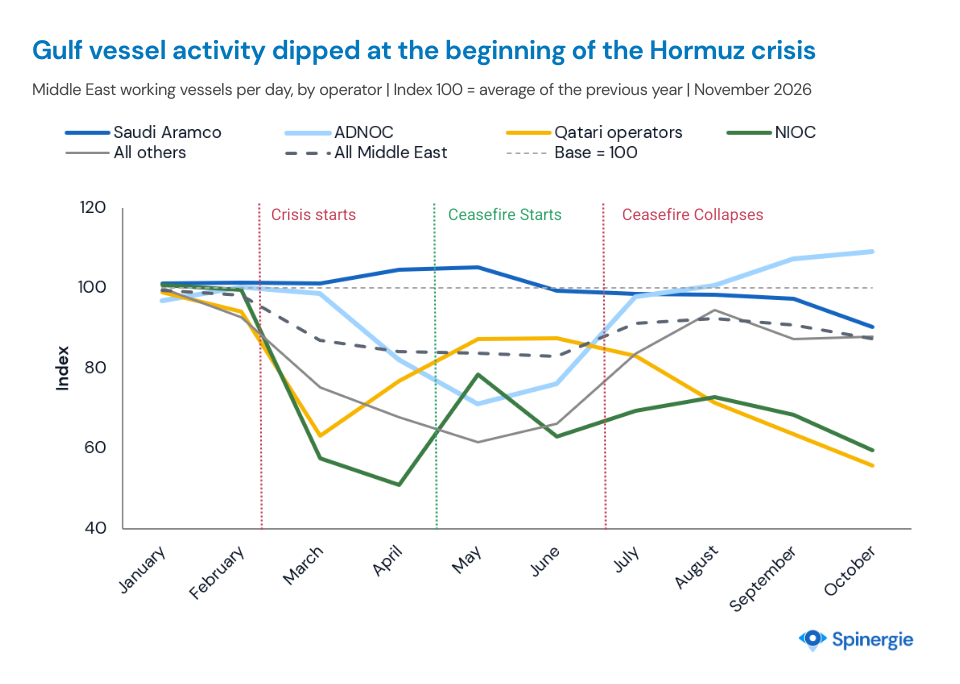
The OSV fleet largely stayed put. Fewer than 2% of AHTS and PSVs left the region, and those that did leave only went as far as the Mediterranean. Project-bound assets (International EPCI construction vessels, dredgers, and heavy load carriers) did leave, and those departures, mobs and demobs, kept the local OSV fleet busy.
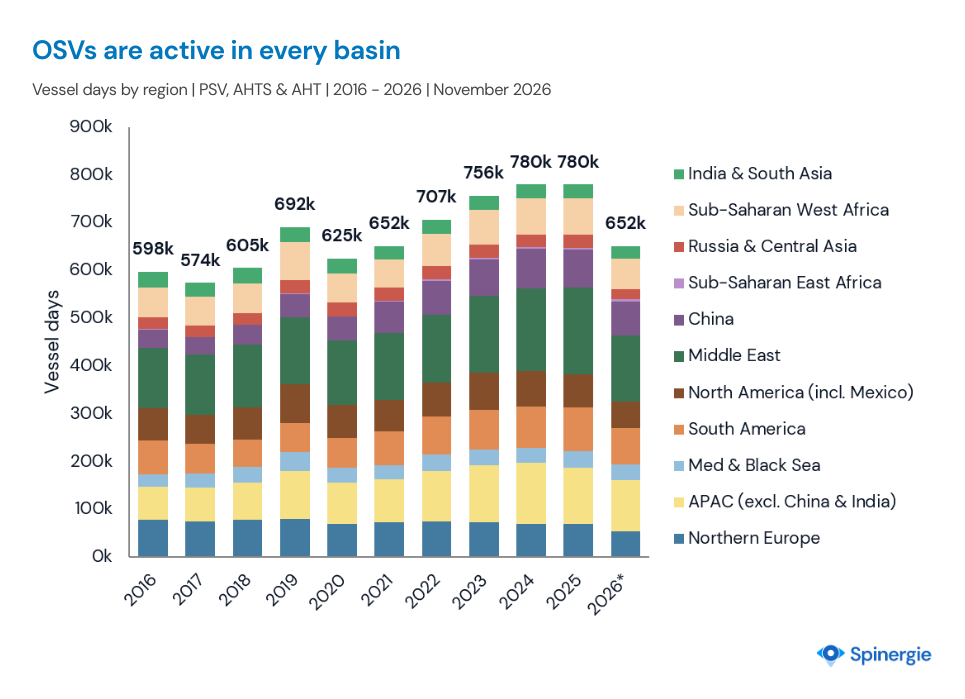
This fits a wider pattern. COVID-19 cut global OSV activity by 20% in 2020, while the invasion of Ukraine caused only a slip dip in Northern Europe due to risks and uncertainty in the Baltic. The fleet only really suffers when physical work stops.
The offshore project pipeline is structural and pre-dates the Middle East conflict. From early indicators like exploration wells and drilling rig contracts, to firm milestones like FIDs, 2026 has been a strong year.
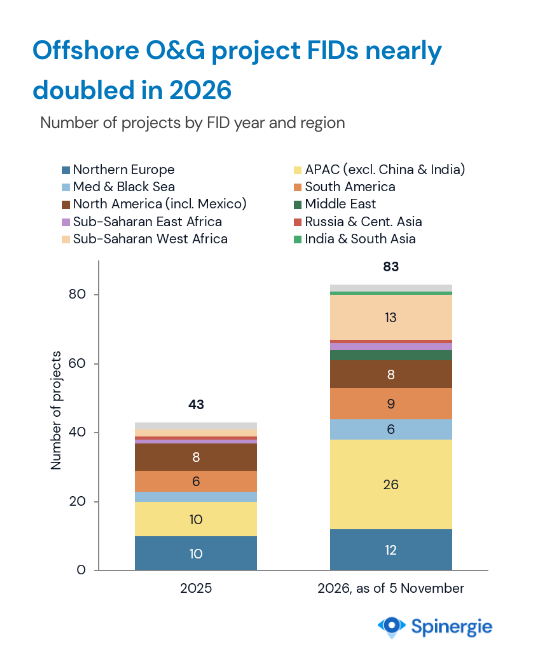
Final Investment Decisions (FID) are the strongest demand signals. This year (2026) has seen a significant uptick in terms of volume and number compared to last year with over 80 projects compared to around 40 in 2025. APAC, led by Malaysia and Indonesia, and West Africa, led by Nigeria and Angola, and the Mediterranean have shown the most growth. APAC more than doubled its FID volume year-on-year with West Africa showing even stronger growth. Furthermore, mature markets like Norway and the USA are aiming towards reserve replacement.
There are three main trends driving this FID uptick.
Existing projects are growing too. Petrobras recently raised its production guidance for 2026 by nearly 10% and raised its capex guidance. The new Búzios FPSOs are ramping up faster than planned, and the operator has the green light to run 11 platforms above design capacity.
Tieback projects are leading demand in 2026, taking two to three years on average from FID to completion. Large deepwater projects built around a floating platform will follow later, alongside more conventional expansions with fixed platforms and rigid pipelines.
Demand peaks in 2028, faster than the three to five years from FID to completion that used to be the norm. Operators have compressed lead times, and suppliers have responded with integrated schemes and earlier engagement. For vessels, subsea construction comes first in 2027 and 2028, with floater installation following from 2028 to 2030.
The number of exploration and appraisal wells rose in 2026 - the first time since 2023. By November, that number had already passed the 2025 total, and the contracted backlog should take the year close to 180 wells.
After a decade of capital discipline, operators’ reserve portfolios are lower than they should be. That translates into renewed effort for new development and unlocking reserves through discoveries. West Africa, APAC, and the Mediterranean mirror the growth observed in FIDs, with those efforts spread across many operators, not just the supermajors.
The number of floater (semisubs, drillships) awards have doubled in 2026 (rising by 82% in terms of rig years) with contract durations lengthening. This indicates a tightening floater market, with operators looking to lock in availability when they can.
Rig supply has fallen considerably since the 2014/15 downturn. The subsequent years saw operators seeking contract terminations, newbuilds stuck in shipyards, and several high-spec units idle for long periods. To stabilise the balance sheets, many rig contractors scrapped older or long-term idle assets that would have been too expensive to reactivate. Today, this means less supply and rising dayrates.
Third quarter cash flow rose by double digits year-on-year for several operators, while CAPEX stayed flat or dipped slightly below Q3 2025 levels. Market observations indicate that higher oil prices are translating into returns in the first instance, without impacting capital investment. Operators are using the extra cash to strengthen balance sheets and service debt, and avoiding sudden reinvestment that could destabilise their supply chain. They are playing it safe and stable, therefore, the demand we see is coming from planned projects, not a crisis-fuelled spending spree.
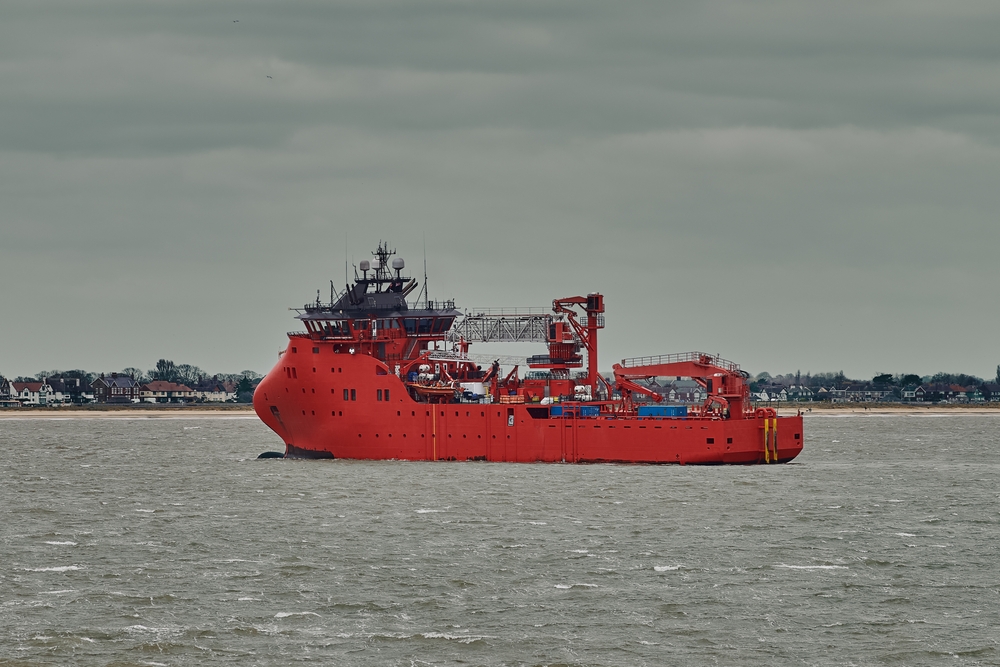
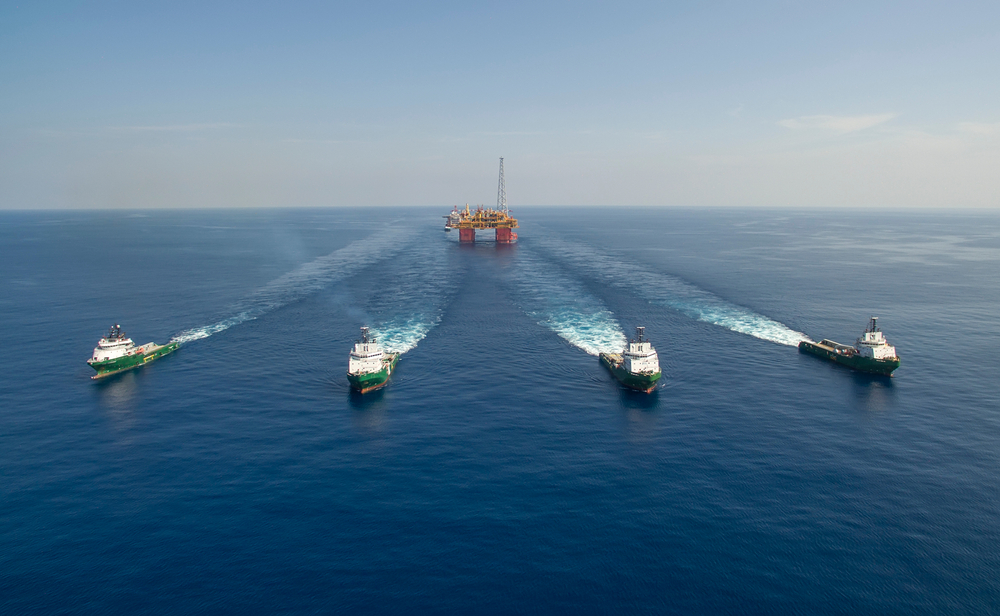
The OSV fleet, the AHTS and PSVs that are involved in almost every stage of a project’s lifecycle, number around 4,500 active vessels. AHTS handle mooring and towing spreads: moving rigs, laying anchors for FPSOs, and towing barges. PSVs supply larger vessels, rigs and platforms in every project phase. OSV activity has been rising for several years across every region, so this is the fleet that will feel the pipeline first.
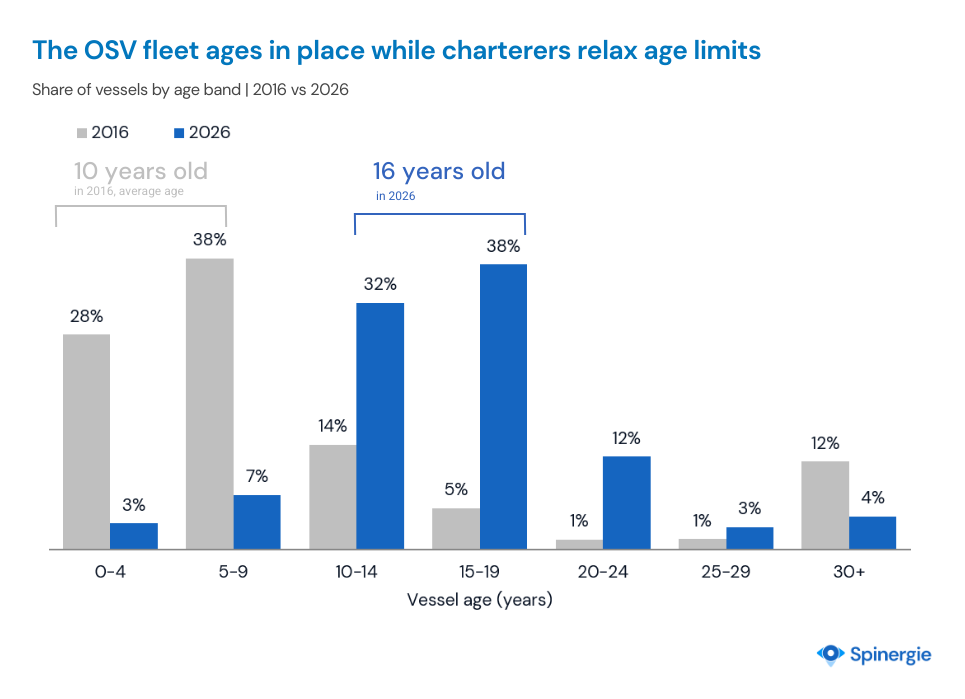
Compared with 2016, the OSV fleet is six years older on average. The large cohorts built in the early 2010s have moved along the age bands, with almost no new vessels behind them. The average would be even higher had many 30-plus-year-old vessels not been scrapped.
Only 3% of OSVs are less than four years old. Charterers used to cap vessel age at 15 years, however many have now pushed that limit to 20 years to accommodate the ageing fleet.
Established OSV owners with strong regional or global footprints are not ordering on speculation. They either build against long-term contracts or not at all, and some buy second-hand vessels while offloading older ones.
The other route to growth is to buy a whole fleet, as observed in Brazil in 2026:
A working fleet with a backlog is faster, and likely cheaper, to acquire than a newbuild. We expect to see more consolidation before real fleet renewal.
Newer players have been more speculative with PSV orders despite high shipyard prices. So far, however, these moves have been without reward with no premiums in rates or selling price for these newer hulls.
Steady FPSO orders have kept yards busy, pushing more redeployment and relocation of existing units. Each move means transits, mooring, and towing spreads, and more AHTS demand as FPSO installation peaks between 2028 and 2030.
Timing will work in the fleet’s favour, at least in the near term. While FPSOs are long-lead items, AHTS are not quite as long-lead. Vessel owners can see the FPSO backlog years ahead, spot the gap in support vessels, and still have time to order and take delivery.
By 2030, however, the 20-year ceiling will start to bite with most of the AHTS fleet, and more than a third of the PSVs, older than the limit.
The deciding factor will be the breakeven point between dayrates and shipyard prices. So far, shipyard prices have increased faster, hence no fleet renewal. Spinergie expects rates to reach newbuild breakeven around 2029. Once one established owner starts refreshing its fleet, it is likely others will follow.
The offshore pipeline is strong, structural, and largely independent of the Middle East conflict. The OSV fleet can absorb it in the near term, but without renewal, it will hit an age wall around 2030. For now, there is still runway before ordering becomes urgent, but the question is who will move first to begin the newbuild wave?
Opportunities will be found within the dense project pipeline. Intelligence by Spinergie tracks the FIDs, rig contracts, exploration wells, and vessel activity behind every trend outlined in this article, and every offshore project. Watch our webinar, ‘Offshore Construction Demand: How the Oil & Gas project pipeline and geopolitics are shaping the market,’ to see the full analysis, then book a demo to see Intelligence by Spinergie in action.