
Sarah McLean
,
Lead Content Manager
Author
, Published on
November 4, 2026

Hugo Madeline
,
Senior Offshore Energy Analyst / Project Manager
Co-Author



Spinergie’s GHG Score and GHG Regulations module are designed to help measure offshore vessel emissions efficiency.
Most emissions regulations were built for the shipping sector where a vessel moves from Point A to Point B. As such, emissions benchmarks are traditionally designed to measure how efficiently a vessel moves cargo or passengers over distance. This logic does not work for the offshore sector.
In the offshore sector you might have a PSV on dynamic positioning (DP), an SOV stationary at a wind farm, or an AHTS on tow. All of these scenarios see vessels working in modes that don’t apply to the cargo-per-mile metric that regulations are based on. Trying to fit these vessels into a merchant shipping framework will not accurately reflect how they actually burn fuel.
That creates a problem for anyone benchmarking the offshore vessel fleet. Charterers screening vessels, owners comparing their fleet with the competition, developers weighing non-priced criteria in offshore wind tenders, and companies reporting ESG all need a fair way to compare vessel emissions.
Intelligence by Spinergie includes two tools specifically designed to help those looking to measure vessel efficiency. The GHG Score provides an emissions benchmark built for offshore fleets. Alongside it, a GHG Regulations module shows which emissions rules each vessel falls under.
Inspired by the IMO’s Carbon Intensity Indicator (CII), Spinergie’s GHG Score benchmarks a vessel on its estimated greenhouse gas (GHG) emissions rate. The GHG Score is the weighted average of a vessel’s GHG intensity across the three main offshore sector operational activity types: transit, at port, and working offshore.
Every scored vessel gets two values:
Vessels are only graded against their peer fleet. A peer fleet groups vessels by main purpose (PSV, SOV, AHTS etc.) and by whether they are DP-capable. An A-grade PSV and an A-grade pipelayer are therefore not directly comparable.
Read Next: How an Activity-Indexed Carbon Intensity Indicator (AICII) works for the offshore sector
The worst-case emissions profile is calculated via a reference fleet - a simulated version of each peer fleet with no environmental technologies on board.
A real vessel score is placed within that reference distribution with A to E boundaries set at specific percentiles. Since the baseline assumes no green technology, vessels that are equipped with green technologies and that use cleaner fuel can earn better grades.
Boundaries are recalculated once a year to reflect fleet evolution, as new vessels are delivered and older ones are scrapped.
Next to the score, each vessel page now shows its status under the four main international GHG regulations, based on vessel type, size and operating area. This clearly shows whether a vessel falls under IMO CII, EU ETS, EU MRV and FuelEU Maritime. It also shows when the vessel will be included in line with evolving regulations. For example, a 5,000t SOV currently falls under the EU MRV regulation, but won’t fall under EU ETS (if operating in the EU) until 2027.
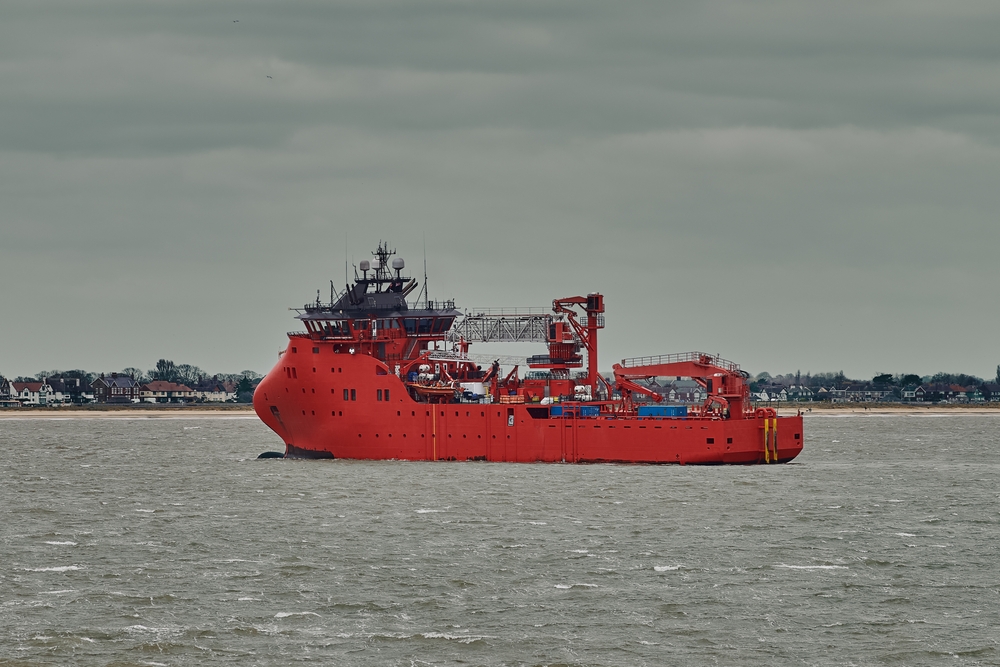
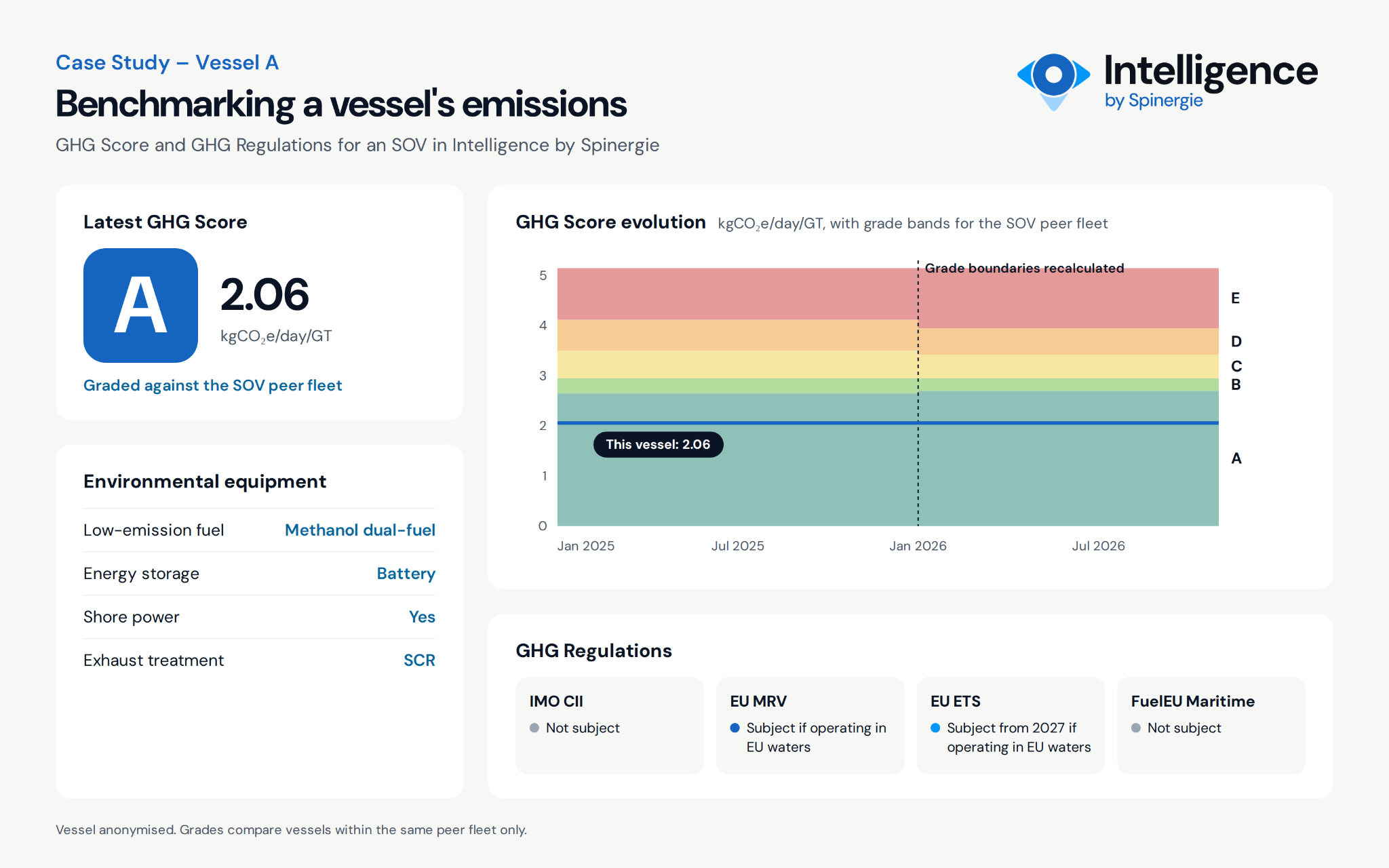
Vessel A is an SOV with 6,817 t gross tonnage currently operating in the UK. This vessel scores A at 2.06 kgCO2e/day/GT, against its SOV peer fleet. Its environmental equipment explains why:
The GHG score evolution chart shows the score sitting comfortably inside the A band. It also shows the grade boundaries shifting on 1 January 2026, when the annual recalculation took place.
The GHG Regulations panel gives the typical profile of a large offshore vessel. It is not subject to IMO CII or FuelEU Maritime. However, it is subject to EU MRV when operating in EU waters, and it will fall under EU ETS from 2027 when operating in EU waters.
Read Next: Maritime emissions regulations—The complete guide.
The GHG Score is designed to be used by anyone who needs a readily accessible tool in order to understand and compare vessel emissions. Use cases may include:
The GHG Score methodology is explained in full within the Intelligence by Spinergie app. This means it is easy for users to share and explain their scores to clients, partners, and other stakeholders.
The GHG Score and GHG Regulations section are available now for all Intelligence by Spinergie vessel module subscribers. They can be found on every vessel’s technical specifications page. Follow the in-app links to find the full methodology in the help centre.
Not a subscriber yet? To see the GHG Score in action, book a demo and our team will tailor it to your business needs.