.png)
Maélig Gaborieau
,
Senior Offshore Wind Analyst
Author
, Published on
October 12, 2026
.png)
Hugo Mahiou
,
Lead Wind Analyst
Co-Author



Spinergie analysts Maëlig Gaborieau and Hugo Mahiou break down the 11 AO10 offshore wind sites, scoring criteria, challenges, and supply chain risks.
On 12 October 2026, offshore wind developers submitted their offers for AO10, France’s largest offshore wind tender to date. Split almost evenly between bottom-fixed and floating technology, the tender comprises 11 projects totalling 9.7 to 11.1 GW. The round merges the former AO9 and AO10 procedures into a single call for tenders. Winners are expected to be awarded in early 2027 and the projects are expected to enter service between 2035 and 2038.
AO10 offers more capacity than all previous French offshore wind tenders since 2011 combined.The tender follows the third multiannual energy programme (PPE3), which sets a target of 15 GW of offshore wind to be in service by 2035 and 45 GW by 2050. This equates to around 20% of projected French electricity demand.
France currently operates around 2 GW across its first commercial wind farms, with a further 1 GW under construction. Following the 12 October AO10 bids, the CRE has 12 to 14 weeks to rank them before the energy minister designates the winners. Each winner will receive a 25-year Contract for Difference (CfD).
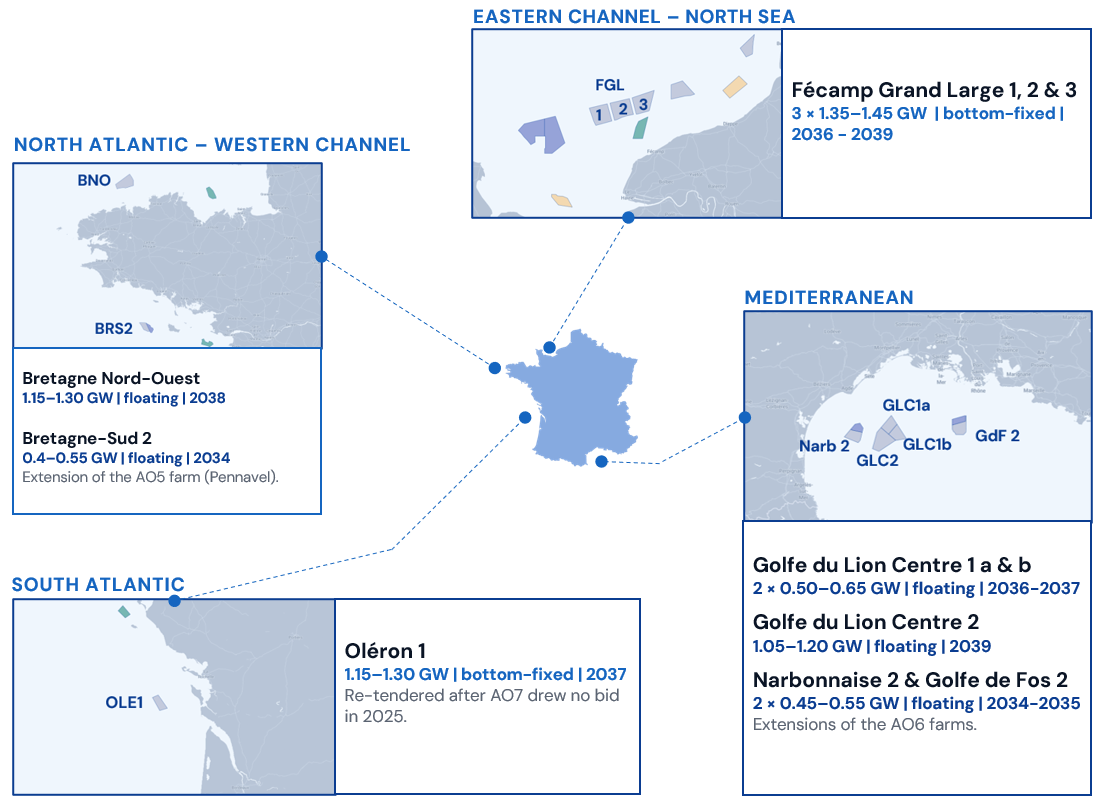
The 11 sites cover all four maritime façades. Bottom-fixed capacity, totalling around 5 GW, is concentrated in the eastern English Channel off Normandy, including three 1.35 GW plots at Fécamp Grand Large, plus the Oléron 1 site in the South Atlantic. Floating capacity, also totalling around 5 GW, is spread across north-west Brittany (1.2 GW), the South Atlantic, and the Gulf of Lion in the Mediterranean.
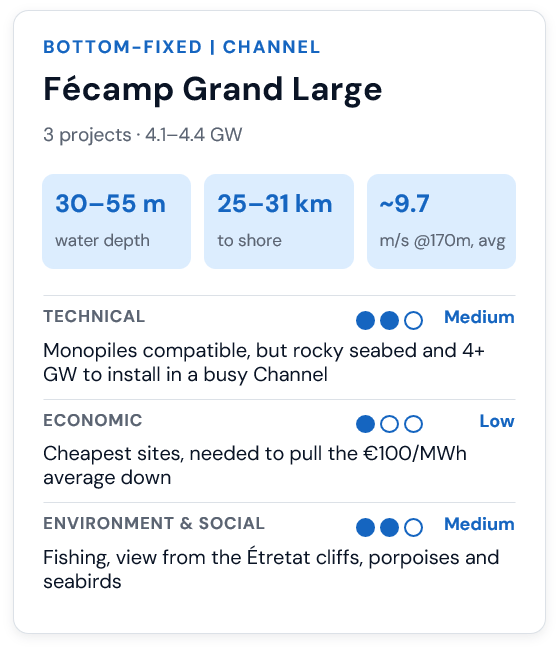
The Fécamp Grand Large (FGL) sites are expected to attract the most competition. These sites are characterised by bottom-fixed technology with decent wind speeds, situated not far from shore, with average water depth below 50m. The latest French AO8 tender featured a site in the same area and similar site conditions, and was awarded to TotalEnergies at 66€/MWh in October 2025.
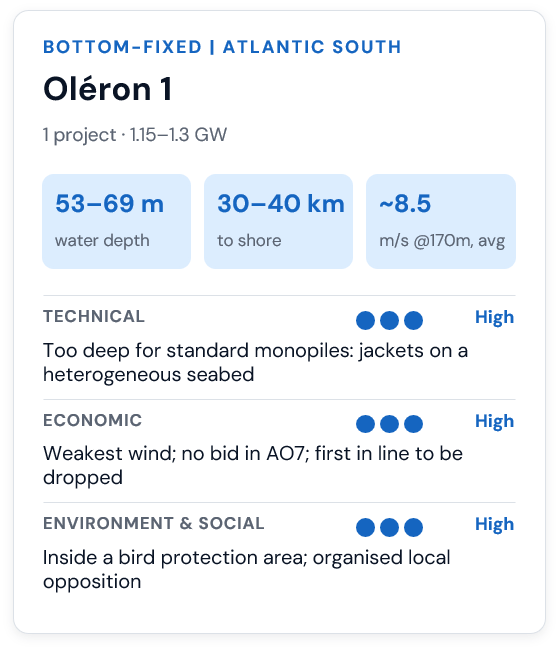
Oléron 1 on the other hand, while also being bottom-fixed, presents a number of challenges. With an average water depth of more than 60m, difficult seabed conditions and very low wind speeds, building a profitable project will require a significantly higher bid price. In fact, Oleron 1 was originally tendered as AO7 in 2025 with a price cap at 100€/MWh, and received no offer.
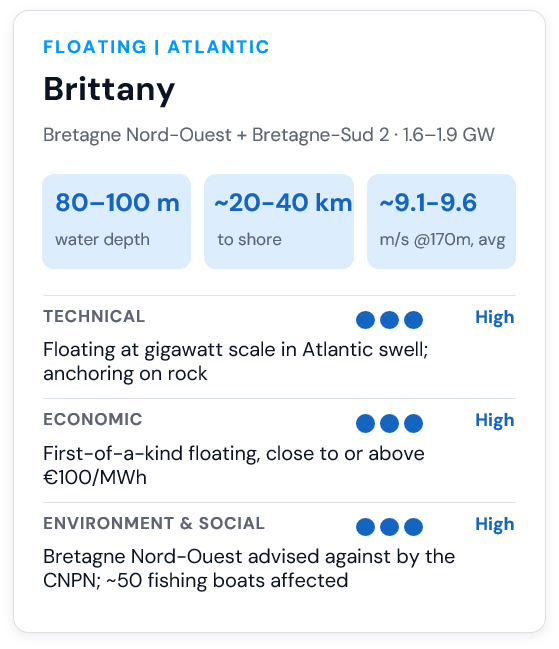
The other half of the capacity awarded will be for floating sites, a technology with no commercial-scale precedent anywhere in the world. Three of these sites are 500MW extensions to previously awarded projects from AO5 and AO6. Mediterranean sites benefit from the best conditions: very high wind speeds; mild, average wave heights; soft seabeds compatible with drag anchors and average water depths between 90-95m. On the other hand, South and North Brittany sites will operate in harsher environments, with a lower wind resource and a harder seabed that might require drilling, at 85-90m average water depth.
Furthermore, worldwide floating wind capacity amounts to less than 500MW. Delivering around 5 GW of floating capacity in France only by 2035-2040 assumes that the supply matures quickly within the decade.
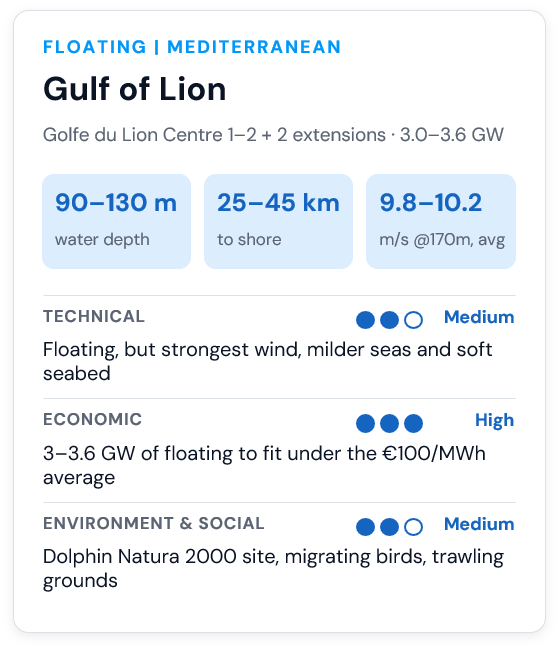
The economic framework targets a capacity-weighted average price of all provisional winners below €100/MWh (in January 2024 euros, indexed) over 25-year CfD. If it does, the CRE drops bids for projects above the target, starting with those connected to the grid last, until the portfolio fits.
This is a demanding target for a round in which 5 GW is floating: the UK’s AR7 awarded at ~256 €/MWh, 2024 prices, to the Erebus and Pentland floating projects in January 2026. In practice, competitive Fécamp Grand Large bids will likely have to pull the average down to make room for floating.
Within each project, bids are scored out of 100 points. Price keeps 70; the other 30 reward robustness, the carbon footprint of manufacturing, and supply-chain resilience.
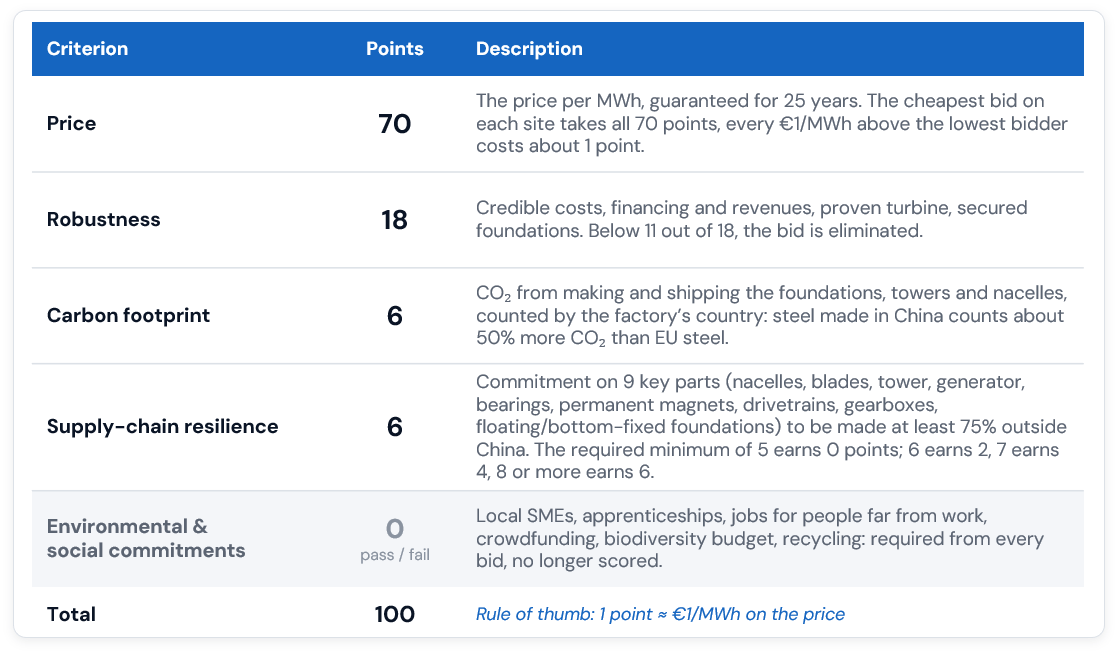
Compared to previous French tenders, robustness criteria were significantly increased, from 5 points in AO5 to 18 points in AO10. The turbine model must at least exist as a tested prototype as a design on paper, however credible, is no longer enough. This might deter speculative bidders banking on 23+MW turbines being available for the project, as we have seen in the past.
AO10 also goes further than any previous French round in filtering out non-European suppliers. It is the first tender to apply supply resilience criteria derived from the EU Net Zero Industry Act. For at least 75% of turbine-plus-foundation assemblies, the final product must not originate from a dominant third state, at least five of nine main components must come from outside that state.
Cybersecurity rules reinforce the same filter. Wind farms are now treated as critical infrastructure, so bidders must demonstrate from the outset how they will protect against intrusion, keep control of the farm in European hands, and submit control systems to an independent audit before production starts, conditions under which Chinese turbines and their control software face scrutiny few bidders will accept.
This tender was suspended, redesigned and relaunched between 2024 and 2026 amid successive government changes, and the PPE3 that underpins it has still not been adopted through a stable parliamentary majority. Furthermore, awards in early 2027 will land just months before the presidential election, and several candidates have questioned offshore wind support levels. Contract signature, grid commitments by RTE and the durability of the 25-year revenue framework all depend on political continuity that France has not demonstrated since 2024.
Read More: White Paper - How upcoming presidential election results could impact French offshore wind (English Version) / L’éolien offshore face à l’élection présidentielle de 2027 (Version française)
Assuming the turbine standardises at around 15 MW, 10 GW translates to roughly 670 turbines. That is more than a full year of combined nacelle output from Siemens Gamesa and Vestas, and it arrives on top of UK AR7 (around 540 turbines) and continued demand from Germany and the Netherlands in the same delivery window. A positive output for this tender round will have to lead to factory expansion and opening to sustain this demand. The 25-year revenue framework will therefore help to justify future investments.
Foundations split the burden. The bottom-fixed half, around 330 units, falls on a European monopile and jacket base already running near capacity, with Chinese suppliers now constrained by the resilience criteria. The floating half requires around 330 floaters, each demanding thousands of tonnes of steel or concrete, serial fabrication methods that do not yet exist at this scale. Non-Chinese permanent magnet supply above 50% per project is a further constraint, given China's current share of around 90% of global production.
Floating wind will also shift the logistics burden onshore. Unlike bottom-fixed projects, floaters are assembled at quayside and towed to site, which requires heavy-load quays, deep berths, large lay-down areas and wet storage. Fos-sur-Mer and Port-La Nouvelle are developing capacity for the Mediterranean zones, and Brest and La Rochelle position themselves for the Atlantic, but none has yet demonstrated throughput at the rate 5 GW by 2035-2040 implies. Several gigawatt-scale projects assembling simultaneously would saturate available quay space, and port investment decisions need to be taken years ahead of project FID.
AO10 gives European suppliers what they have asked for since 2023: volume, visibility and a preference framework that rewards regional manufacturing. If awarded as planned in early 2027, it anchors a French pipeline through 2040 and positions France as the first market to industrialise floating wind at gigawatt scale.
The conditions attached to that outcome are real. A sub-EUR 100/MWh average price, strict sourcing rules and an unproven floating supply chain pull in opposite directions, and bidders will price that tension into their offers. The number and quality of bids received on October 12 will show whether the balance holds. Our view is that the bottom-fixed plots in off Normandy will clear comfortably, while floating awards will test both the price cap and the resilience criteria.
.jpg)