.png)
Maëlig Gaborieau
,
Senior Offshore Wind Analyst
Author
, Published on
October 15, 2026

Chen-Yu Lee
,
Co-Author



Fifteen Chinese HLVs have entered the international market since 2022. What’s driving the shift and will more follow?
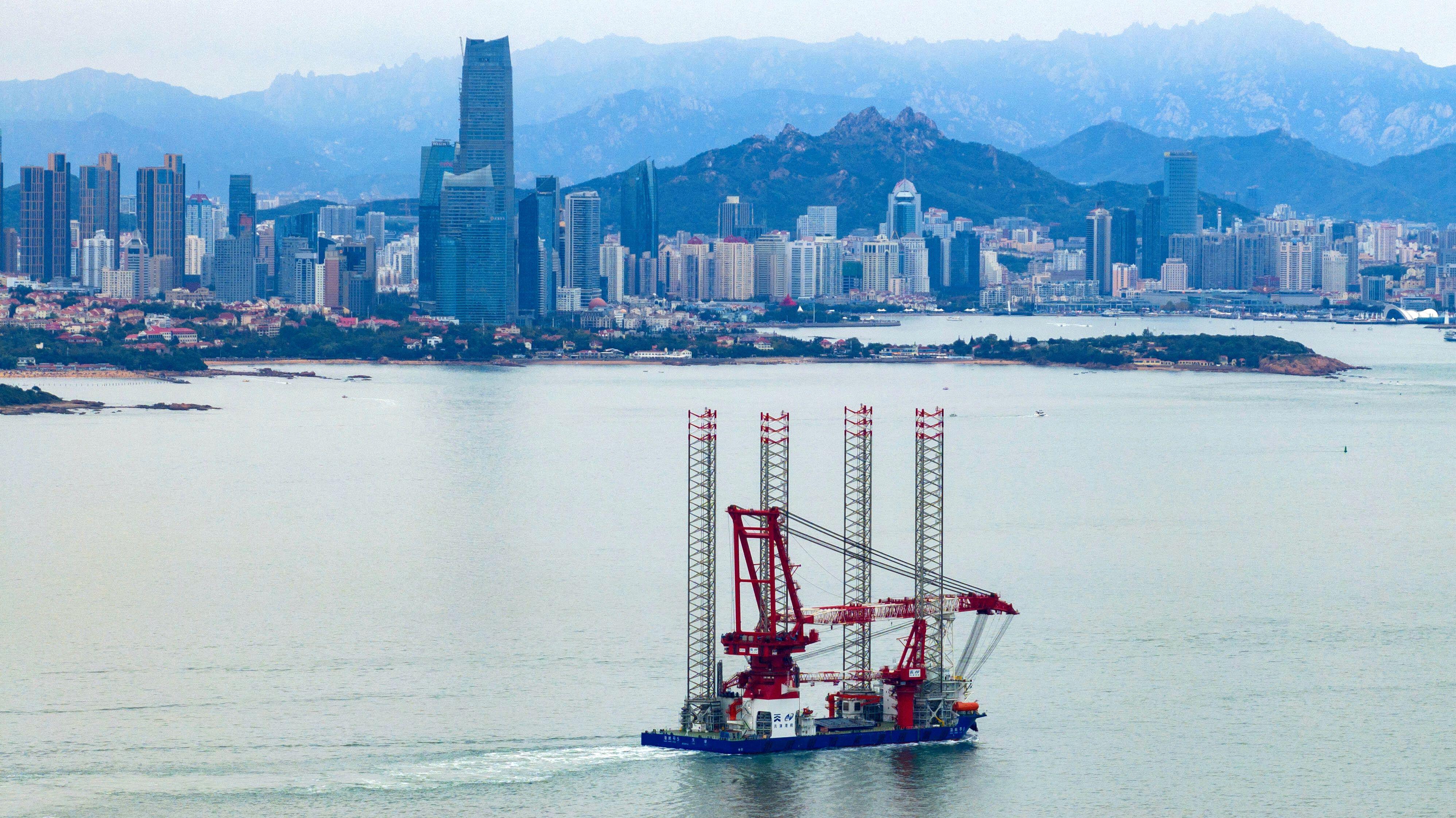
With 101 active heavy lift vessels, China operates a fleet larger than the combined international market of 86. Traditionally, the Chinese fleet remained within the home market, but since 2022 the flow of vessels has turned, with 15 moving into the international market. Drawing on Spinergie’s updated Chinese HLV database, we examine how a subsidy-driven installation rush reshaped the fleet, and whether China is set to become a lasting source of tonnage for the international market.
Note: Spinergie defines a heavy lift vessel as a vessel, barge, jack-up with a total crane capacity equal or above 500mT., that is dedicated to heavy lifts such as wind farm foundations, turbines etc.
Unlike the increasingly interconnected component supply chain, Chinese and international HLV fleets have historically operated largely within their respective markets. Cross-market movements remain limited, but occur in both directions. There are a few key examples:
Chinese vessels Bo Qiang 3060 and Shun Yi 1600, now named Wind Keeper and Hansan 1 respectively, became international acquisitions.
Taillevent was acquired by HuiHai 1 Wind Power (renamed Hui Hai Yi Hao) in 2021 before being acquired by Ziton (and renamed Wind Discovery) and moved back to the international fleet in 2024.
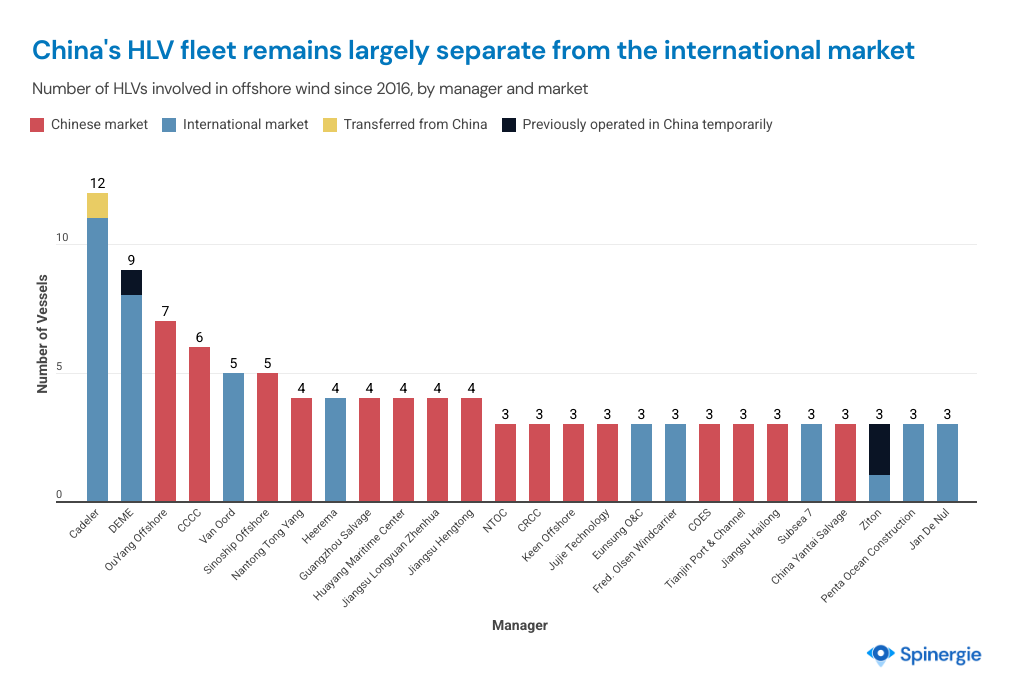
Unlike the international market, where Cadeler and DEME operate the largest fleets, Chinese capacity is spread across a broader range of domestic players. OuYang Offshore and CCCC operate the largest Chinese fleets, followed by SinoShip Offshore and several managers with three to four vessels each.
In 2019, the China's National Development and Reform Commission (NDRC) introduced a new offshore wind pricing policy (发改价格〔2019〕no. 882), requiring previously approved projects to connect by year end-2021 to retain their existing feed-in tariff levels. In 2020, a central subsidy reform (财建〔2020〕no. 4) reinforced the deadline, requiring eligible projects to fully connect by year end-2021 to retain central government subsidies.
The deadline triggered an unprecedented installation rush. China connected 16.9 GW of offshore wind in 2021, while Chinese HLV working utilization reached 83%, which is around 30 percentage points above the international fleet.
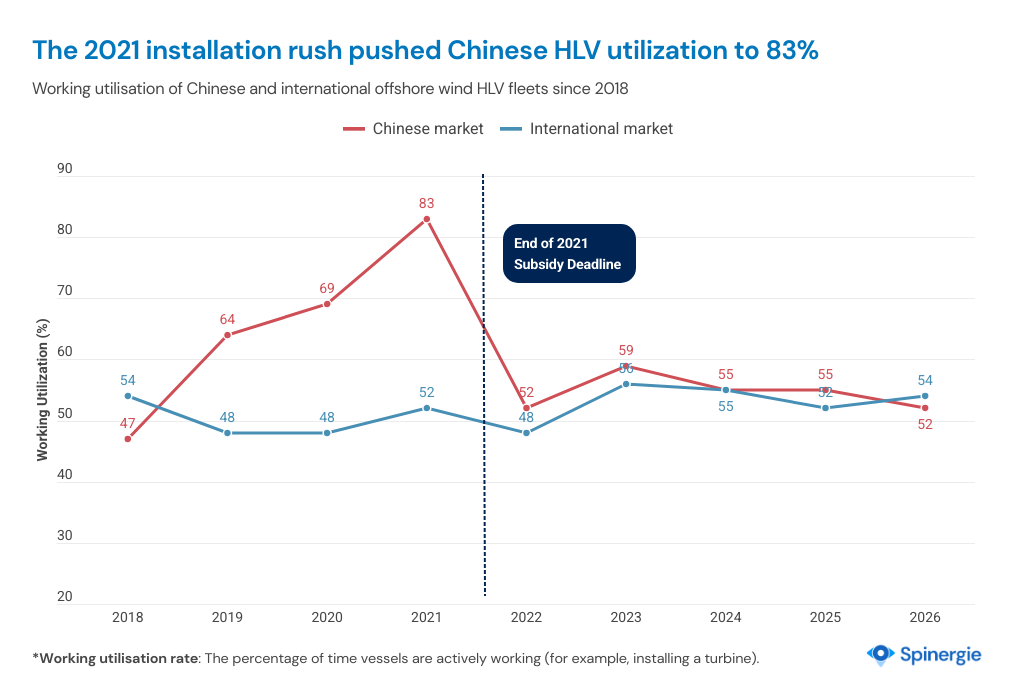
The 83% Chinese working utilisation rate was not only far above the country's historical level, but also around 30 percentage points above the international fleet in the same year.
The 2021 experience therefore provides an observed example of how high installation-vessel utilisation can reach when a large project pipeline is compressed into a short period. Strong policy support and a hard commissioning deadline directly drove the exceptionally intensive use of the installation fleet.
The peak was short-lived. Once the subsidy-driven installation rush ended, Chinese working utilisation fell to 52% in 2022 and has since remained close to the levels observed in the international market.
While international HLV deliveries were already established in the early 2010s, Chinese newbuild activity accelerated from 2018 onwards. The largest wave came in 2023, when 27 Chinese market HLVs were delivered, which is two years after working utilization had peaked.
Historically, the timing between an order for a new-build installation vessel and its delivery spans between two and four years. High utilisation through 2019–21 encouraged fleet expansion, but by the 2023 delivery peak, Chinese working utilisation had already returned to levels comparable with the international market.
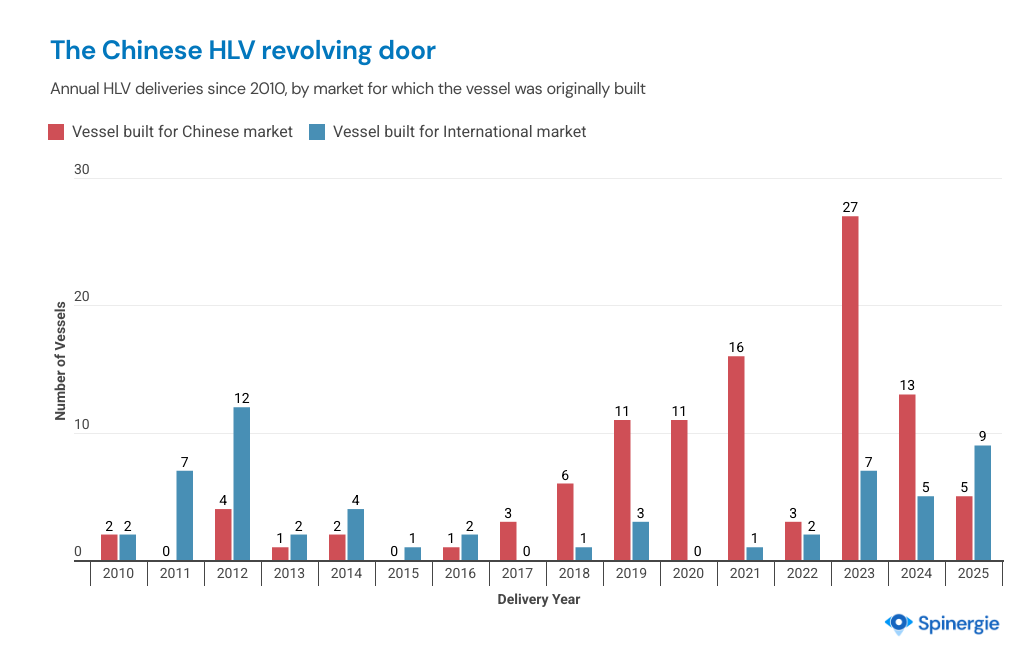
Four international HLVs entered China in 2020–21, around the peak of the installation cycle. The direction subsequently reversed: 15 vessels moved from China to international markets between 2022 and 2025, including the four vessels that had previously entered China.
With government support shifting from the national to the provincial level, another nationwide
2021-style utilisation spike appears less likely. China nevertheless retains a large offshore wind pipeline, suggesting continued domestic vessel demand alongside potential opportunities for selected HLVs to be sold or redeployed internationally. This is especially key in APAC countries with cabotage laws and a lack of installation vessels, such as South Korea.
Spinergie has conducted a comprehensive update of its Chinese heavy-lift vessel database, reviewing active vessels and their management structures to provide a more complete view of China's offshore wind installation and maintenance fleet.
The Chinese fleet includes vessels operated by Chinese companies primarily within the Chinese offshore wind market. All other vessels are classified as part of the international fleet.
The analysis covers active vessels only and excludes future newbuilds.
Spinergie analysis considers vessel managers rather than owners, as asset owners may appoint specialized ship-management companies to operate their vessels. Where relevant, subsidiaries belonging to the same group are consolidated under their parent company.
Find out more about Intelligence by Spinergie or request a demo.
.jpg)