.png)
Hugo Madeline
,
Senior Offshore Energy Analyst / Project Manager
Author
, Published on
August 18, 2026

Sarah McLean
,
Lead Content Manager
Co-Author



How to adapt Carbon Intensity Indicators (CII) for offshore vessels to measure and compare emissions accurately.
.jpg)
Evaluating a vessel’s performance against its peers has been a persistent offshore challenge. While the shipping industry has moved towards standardised benchmarking, helped by the International Maritime Organisation’s (IMO) Carbon Intensity Indicator (CII) regulation, it is less straightforward for the offshore sector.
A clear, industry-wide indicator would provide real efficiency metrics and offer the opportunity to find meaningful emissions reductions. Below we share why the current CII regulation is still not suitable for offshore vessels, and how Spinergie is bridging the gap with an accurate, activity-based CII.
In January 2023, the IMO introduced the CII as an annual efficiency target, aimed at forcing ships to cut emissions by getting stricter over time. Established as part of the IMO’s strategy to reduce the carbon intensity of shipping by at least 40% by 2030, the CII measures the efficiency of a maritime transport unit. However, the current regulation only applies to ships transporting cargo or passengers of, or over, 5,000 GT such as tankers, bulk carriers, and container ships.
Under the current regulation, ships are given an annual rating between A and E which is based on their CO2 emissions per unit of “work” (generally capacity multiplied by distance travelled). Intervention is required for persistent D ratings or a single E rating.
Offshore support vessels (OSVs), subsea construction vessels, WTIV jack-ups, and a multitude of other offshore vessels, remain largely exempt from the IMO’s CII rating system.
This is because the IMO’s CII rating system was designed for transport. For a bulk carrier, “work” is defined by moving from Point A to Point B—distance is the primary metric. However, for an offshore vessel “work” often involves the vessel staying in one place: maintaining its station using dynamic positioning (DP), performing subsea lifts, or supporting an offshore drilling rig.
Under the current IMO formula, a vessel working hard in a single location without any distance travelled would receive a failing grade, even if the vessel is performing efficiently. Therefore, because the “work proxy” for offshore is so fundamentally different from transport, the IMO has yet to uncover a formula that doesn’t unfairly penalise the sector.
While there remain no IMO mandates, organisations like the International Marine Contractors Association (IMCA) have stepped in. In February 2022, the IMCA proposed two proxies:
This is a step in the right direction, however, it continues to leave room for inconsistencies to slip through. Spinergie undertook a close analysis of six major OSV players and discovered that they are using at least three different indicators across their reporting.
A case study of one vessel highlighted the danger of inconsistent metrics. Despite the vessel performing the exact same operations in consecutive years, and with no changes in vessel design, its Carbon Intensity “improved” by 11% simply because it spent less time in transit. The vessel didn’t actually become more efficient, the CII formula simply favoured one activity over another.
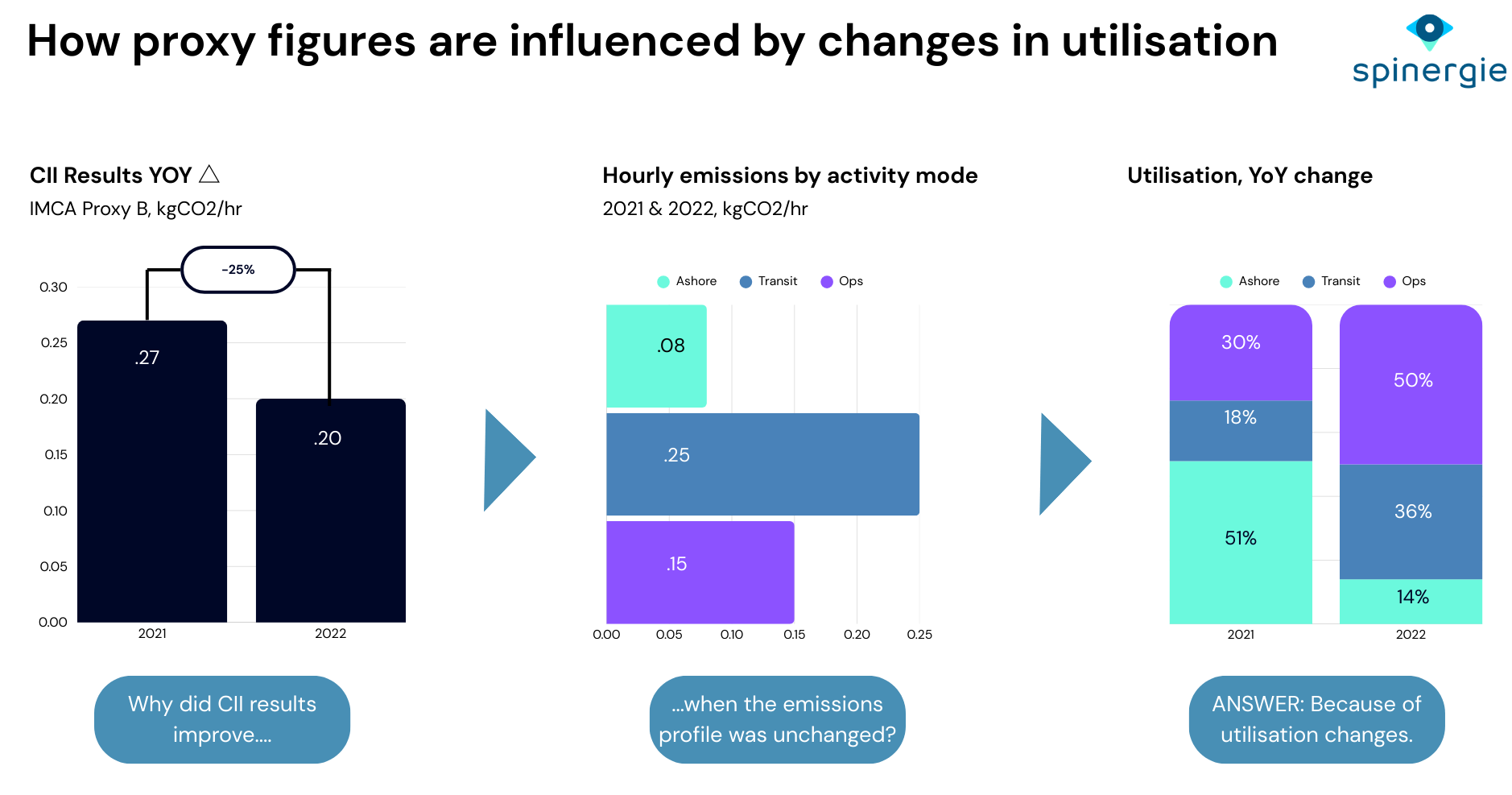
Calculating carbon intensity for non-transport vessels is inherently complex. As we have seen, in shipping distance travelled is an accurate proxy of work done. But in the offshore sector, work cannot be solely defined by this metric.
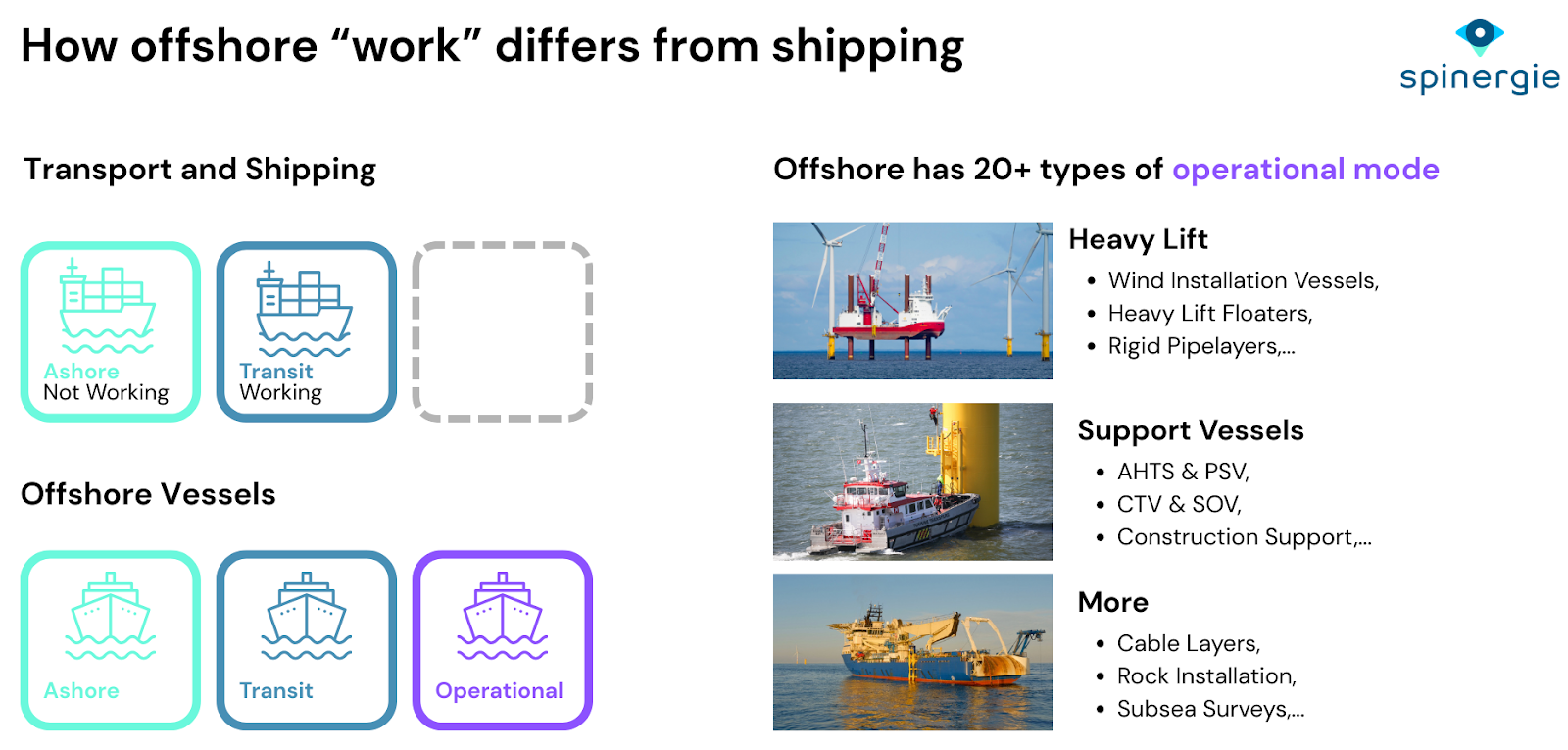
Offshore work is generally split into three distinct modes: time ashore, time in transit, and operational—the latter can include significant metric variations, just to add to the complexity. Spinergie proposes that a single CII does not work for this fleet, instead, we suggest calculating CII per activity category.
By breaking down emissions by activity mode, vessel owners can directly target specific decarbonisation levers. For example, directly improve the “ashore” metric by installing shore power systems.
To allow for high-level fleet comparisons, we suggest applying weightings to these activities based on the vessel’s primary purpose. This generates an accurate overall indicator that remains independent of any varying utilisation factor.

For CII to work in the offshore sector it needs to be unique and tailored to its complex operations. This is the only way to ensure transparent environmental assessments, set clear efficiency targets, and encourage honest benchmarking between fleets.
Through Spinergie’s proxy model, which includes detailed activity-level tracking, vessel owners can finally move past confusing metrics and towards reduced emissions.
Read how Spinergie has worked with an offshore vessel manager to develop an activity-based CII indicator for their fleet. Interested to see how this could work for your fleet? Book a demo and we’ll talk through how it could work for your unique fleet and operations.