Spinergie
,
Content Writer
Author
, Published on
November 13, 2026
No items found.



We look at how Poland’s offtake model, domestic supply chain and port capacity are evolving, and at the vessel, timing and geopolitical risks facing its 2030 and 2040 targets.
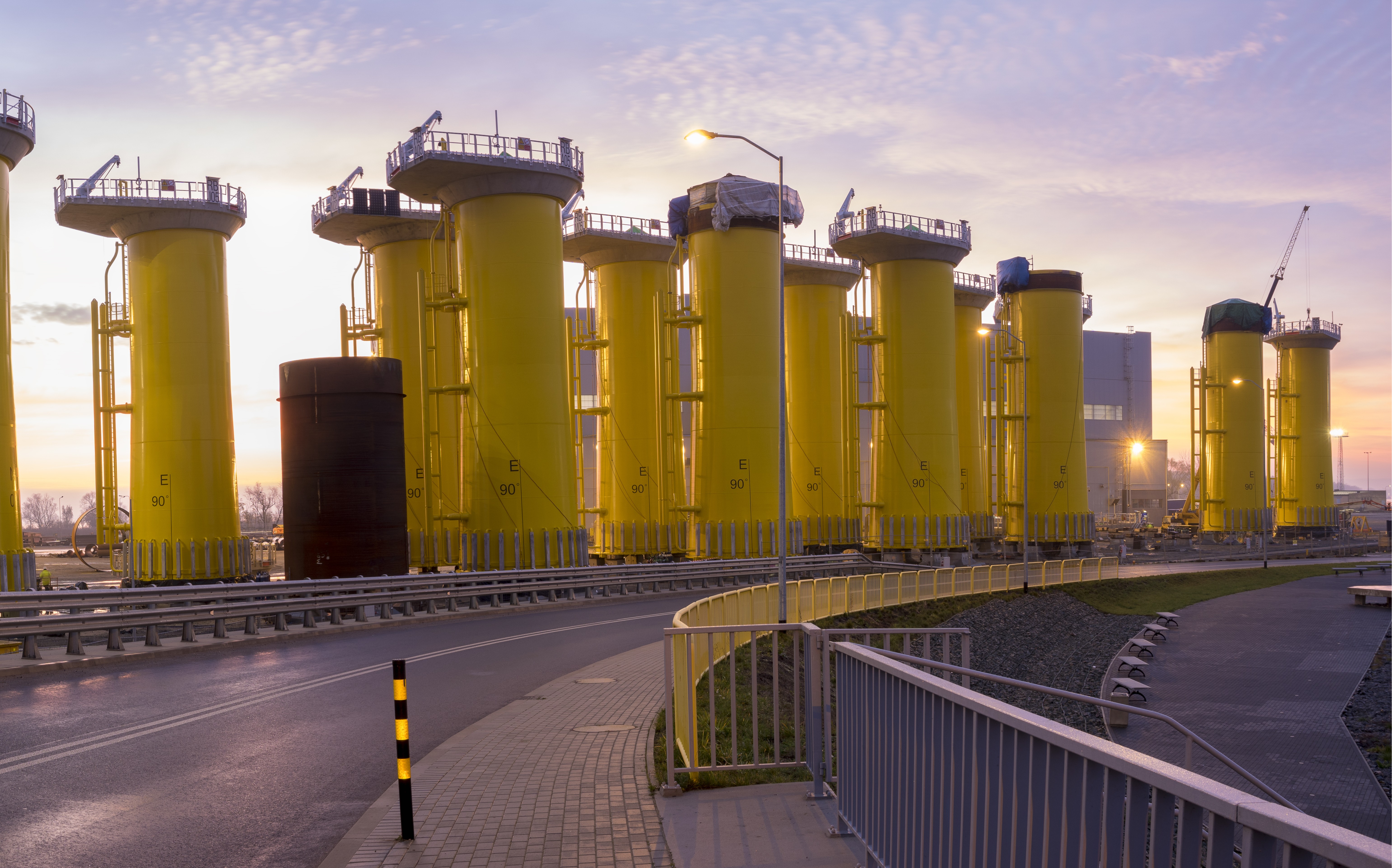
Unlike its Baltic neighbour Germany, which has operated offshore wind turbines since 2011, Poland is a latecomer to the sector. However, with a decline in coal use (from 91% 20 years ago to a current standing of just over 50%), Poland is reducing its dependence on the fossil fuel and leaning further into offshore wind. The Polish government targets 5.9 GW by 2030 and 18 GW by 2040.
On 10 July 2026, the country celebrated its first offshore electricity from Baltic Power, a joint venture between Orlen and Northland. Installation of all 76 turbines was completed in October 2026.
Further Polish deals include Equinor buying 50% of Polenergia’s Bałtyk 2 and 3 in 2018, Orlen agreeing in January 2021 to sell 49% of Baltic Power to Northland, and PGE signing with Ørsted in February 2021 for a 50/50 joint venture on Baltica 2 and 3. The three deals share one structure: a Polish permit holder, often state-controlled, paired with an operator with experience building offshore wind farms.
A turning point for offshore wind in Poland came in 2021, with the adoption of its new energy policy and spatial plan, as well as an Offshore Wind Sector Deal (local content commitments from the industry). Seven Phase I CfDs were granted, five of which reached FID: Baltic Power in 2023 and the other four in 2025, out of a total of six FIDs in Europe that year.
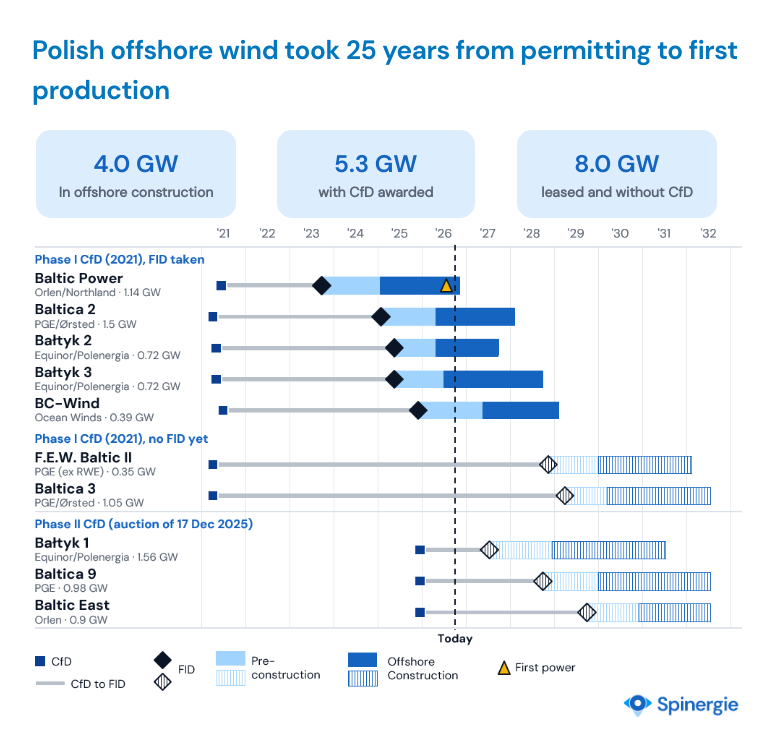
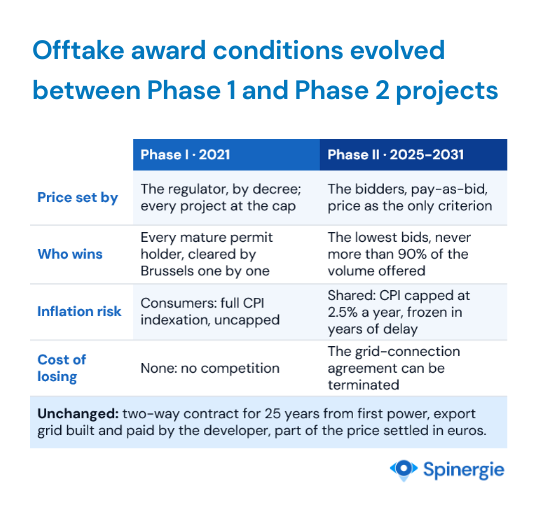
Like most emerging offshore markets, Poland handed its first wave to the projects that already existed and left competition for later. In 2021, the regulator granted 25-year two-way CfDs to seven projects (5.9 GW) holding seabed permits from 2012-2013, at a price fixed by decree (EUR 72/MWh). The goal was to ensure bankability and give offshore wind a strong start in Poland.
The 2022 inflation shock could have stranded those contracts. Instead Poland indexed them fully to CPI, lifting EUR 72 to about EUR 105 by 2026. Five FIDs followed in 2023-2025.
A second wave by auction. The December 2025 auction moved to a competitive process, with prices set by bids (EUR 113-117/MWh). Four bidders for 4 GW, all PGE, Orlen or Equinor-Polenergia, bidding 2 to 4% under the caps. Still, Poland cleared 3.4 GW in a year when Germany's and Lithuania's rounds were unsuccessful.
The 2027 round, with EU non-price criteria, is the next step for Polish offshore wind.
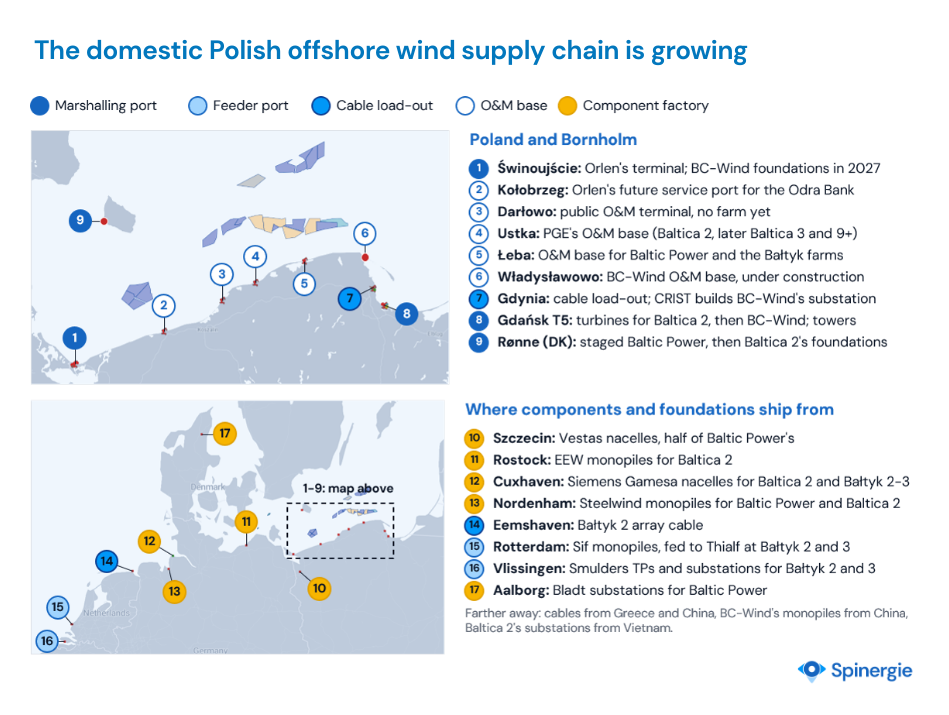
The first Polish offshore wind projects relied on foreign ports. Rønne, on Bornholm (Denmark), marshalled Baltic Power’s turbines and foundations and Baltica 2’s foundations. Bałtyk 2 and 3 did without a marshalling port: Heerema’s Thialf stayed on site, supplied by feeder vessels from Rotterdam and Vlissingen.
Today, a Polish supply chain is taking root, but it is not enough yet. Polish plants now make towers (Baltic Towers, soon Windar), some of Baltic Power's nacelles (Vestas Szczecin), Baltica 2's secondary steel and BC-Wind's substation (CRIST). Most items still come from abroad: monopiles from Germany, the Netherlands and China, nacelles from Cuxhaven, cables from Greece and China, and every installation vessel.
The next campaigns will be operated from Polish quays. Gdańsk T5 stages Baltica 2's turbines from late October 2026 and BC-Wind's in 2028, Świnoujście takes BC-Wind's foundations in 2027, and O&M runs from Łeba, Ustka and Władysławowo. The shift is happening but capacity is still thin.
Foreign ports will be needed for the future projects due in the 2030s. Without a third terminal or a larger Świnoujście, part of the second wave will again be staged from Denmark and Germany.
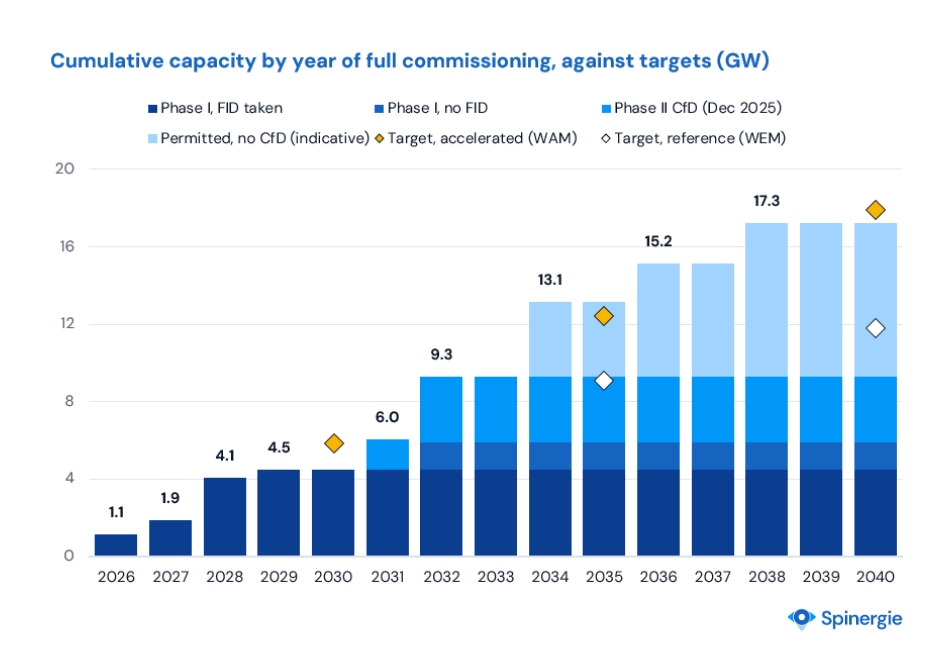
The Polish pipeline is aligned with governmental targets but a pipeline and commissioned projects are not the same thing.
There are two official Polish targets: The energy and climate plan of 8 June 2026 sets 5.9 GW for 2030 and, for 2040, 11.8 GW (reference) or 17.9 GW (accelerated).
The targets set by the Polish government could face three key challenges:
Intelligence by Spinergie tracks all offshore wind projects from initial auction to decommissioning. Reach out to our team to find out how to subscribe.