Sarah McLean
,
Lead Content Manager
Author
, Published on
August 18, 2026
No items found.



Maritime fuel efficiency is now a key commercial differentiator for OSV owners with fuel modelling helping vessel managers secure higher utilisation and contract renewals.
Until recently, the Offshore Support Vessel (OSV) sector rarely viewed fuel efficiency as a primary revenue driver. In most charter models, fuel was reimbursed and operational parameters were largely dictated by charterers. This left vessel owners to focus on dayrate and utilisation rather than consumption performance.
Now, that dynamic is changing. Fuel efficiency is moving from being simply an operational metric to a commercial differentiator. Charterers are establishing benchmarking practices, introducing fuel targets and increasingly linking performance to contract renewals and reimbursement mechanisms. This means that fuel efficiency is now influencing competitiveness and long-term revenue stability.
There are two main reasons why fuel efficiency was not seen as a revenue driver in traditional contracting:
In most charter models, fuel is reimbursed by the charterer. With this model, the vessel owner’s P&L is driven by dayrate and utilisation, not fuel burn. Therefore, fuel performance was often categorised as being of “the charterer’s concern” rather than a strategic priority.
Vessel owners traditionally had limited operational discretion. Sailing orders, speed, and tasking are largely defined by the charterer and operations must be conducted within those parameters. This constrains the vessel owner’s perceived ability to influence fuel consumption.
This combination resulted in fuel efficiency rarely being seen as a true commercial lever. But the tide is turning. Fuel efficiency is becoming a major competitive differentiator and, increasingly, a revenue topic.
Charterers are moving towards efficiency-driven fleet selection with benchmarking as a standard practice. This is leading to vessel managers increasingly being held accountable to predefined targets.
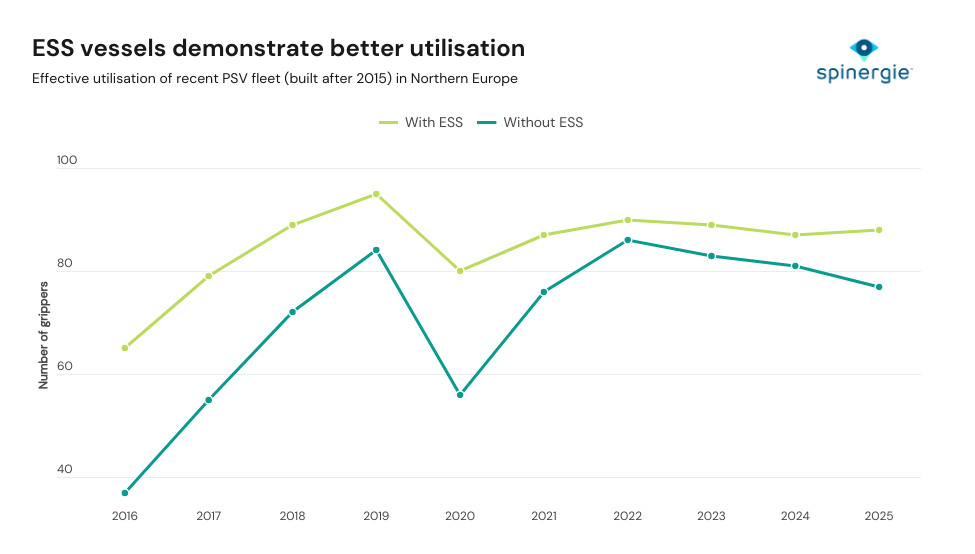
Charterers are prioritising vessels with better fuel efficiency. These more efficient vessels tend to exhibit higher utilisation, longer charter durations, and a greater likelihood of repeat awards. Spinergie Market Intelligence analysis indicates that more efficient vessels display higher utilisation, longer charter durations, and have a greater likelihood of repeat awards. See chart below for analysis.
The implementation of structured fuel consumption reviews between charterer and vessel owner is becoming standard. Many charterers are benchmarking the available fleet through criteria such as comparable vessels, spec sheets, assumptions based on vessel class, activity categories, and data captured during pre-tender sea trials.
Charters begin with the charterer defining an expected fuel burn table with the vessel owner. These tables then become a key reference point for monthly performance reviews, variance analysis and commercial discussions. However, they are frequently unreliable. As they are based on spec sheets, sea trials, and post-shipyard stays they tend to introduce a dynamic of over-promising and under-delivering.
In addition, fuel quota mechanisms are expanding. Programmes implemented by national oil companies (NOCs) and supermajors include fuel reimbursement capped at an expected consumption level and excess consumption to be borne by the vessel owner unless justified. If the vessel owner is unable to confidently establish their fuel table, they are exposed to fuel spend. To prevent this, they can overestimate their fuel table, but this would mean presenting their fleet as less efficient than peer vessels with precise fuel models.
Together these charterer expectations mean that fuel efficiency now directly impacts charter renewals, preferred supplier status, and expense reimbursement.
Digital solutions are necessary for successful chartering and relationship management under these new contractual requirements.
Applying data science to your operational data establishes a clear understanding of fleet fuel performance. Spinergie’s Smart Fleet Management platform offers vessel-specific fuel models based on real operating behaviour - considering the impact of speed, sea states, draft and activity mode - not design specifications, in order to produce conditional normalised fuel tables.
This modelling is applied under a sensor or sensorless approach. This is because, while energy flow metres are valuable, they are not always available across an entire fleet. In comparison, a sensorless model enables consistent analysis across the entire fleet.
High-quality activity data is integrated digital feeds of weather, sea state, currents, speed, and draft to produce a contextual understanding of how and why fuel is consumed. Meanwhile, actual consumption is continuously compared against modelled expectations. This allows deviations to be identified early and to allow users to quantify their magnitude and persistence.
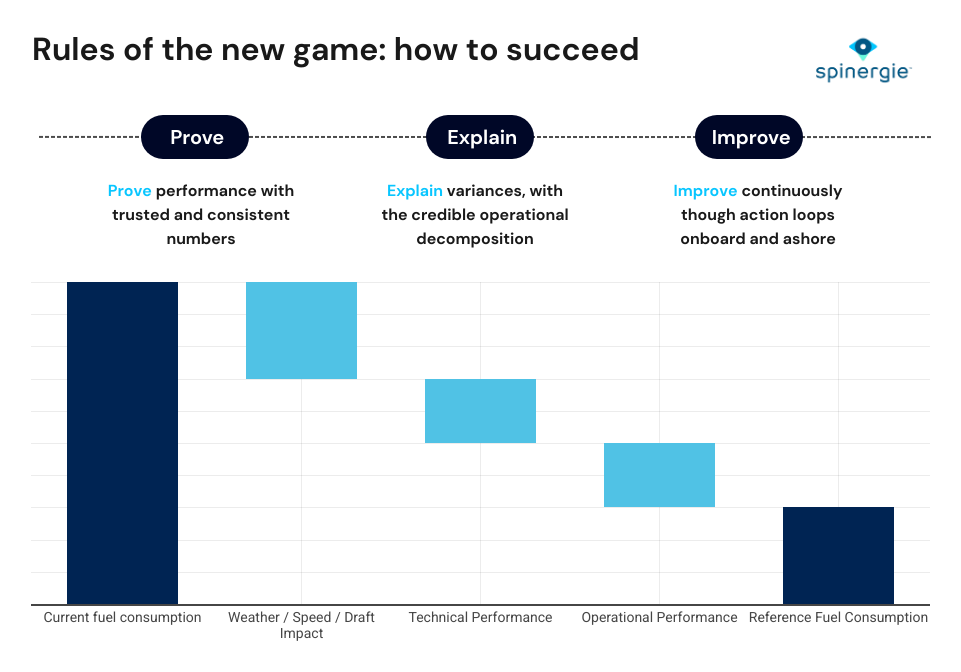
Best-in-class vessel owners explain their fuel numbers, not just defend them to charterers. With digital reporting, users systematically investigate any excess consumption by breaking down variances into clear, credible categories:
Uncontrollable factors: weather and sea state, currents, draft and loading condition, and hull fouling and vessel condition.
Controllable factors: overspeeding, excessive speed variability, suboptimal generator configuration, inefficient operational sequencing, and “hurry up and wait” behaviours.
Equipped with this context, vessel managers engage charterers with transparency. They use this to proactively share insights and align on root excess consumption causes. This approach demonstrates the continuous improvement mindset that charterers are calling for.
Fuel efficiency might once have been viewed as a noble voluntary pursuit, but now it is non-negotiable, offering commercial credibility and value-added service. For vessel managers, fuel may still be reimbursed, but efficiency is key. Efficiency increasingly determines who is shortlisted, renewed, or trusted with the next campaign.
Are you ready to explore how Spinergie Smart Fleet Management will improve your fuel efficiency? We’d love to talk about your fleet and how we can help optimise your operations. Get in touch.

.jpg)