Jean-Baptiste Rougeot
,
Head of Analysts
Author
, Published on
August 5, 2026
.png)
Yvan Gelbart
,
Lead Analyst
Co-Author



Spinergie Head of Analysts, Jean-Baptiste Rougeot, and Lead Analyst, Yvan Gelbart, present a detailed case study of France’s EFGL floating wind farm, tracing its decade-long path from seabed lease to first power and the vessels, contractors, and milestones behind it.
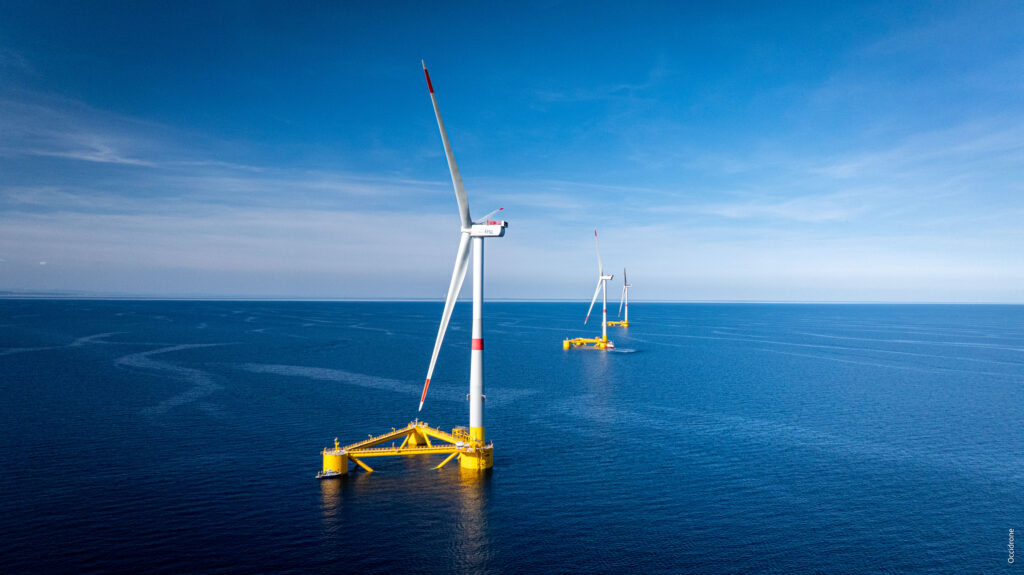
France is taking big strides in floating wind energy, with the landmark Éoliennes Flottantes du Golfe du Lion (EFGL) project providing a key example for upcoming projects. In this insight, Spinergie Head of Analysts, Jean-Baptiste Rougeot, and Lead Analyst, Yvan Gelbart, examine the development of the EFGL floating offshore wind farm.
Read More: What is Floating Wind?
EFGL is a three-turbine floating offshore wind farm in the French Mediterranean. It reached first power in early May with full commissioning set for the third quarter of 2026.
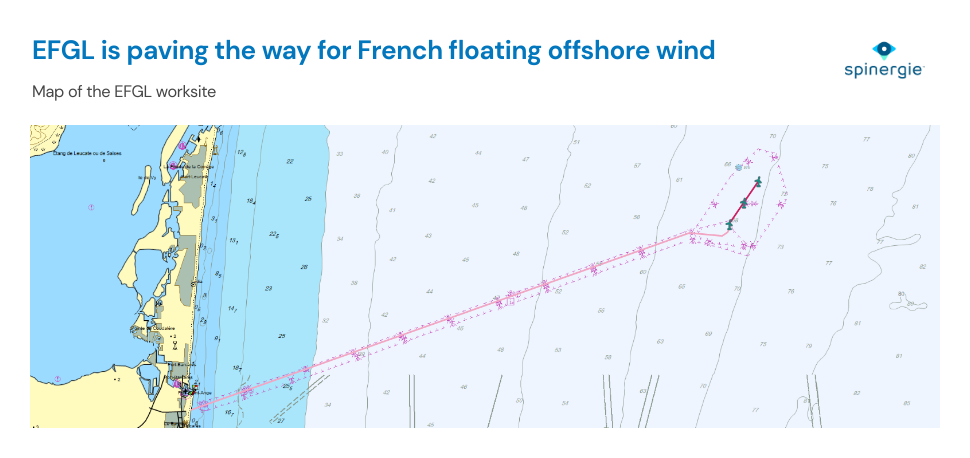
The French state awarded the EFGL seabed lease on 4 April 2016, under the floating wind pilot scheme. A consortium of three developers - ENGIE, EDP Renewables, and the Caisse des Dépôts group - were the winners of the Les Eoliennes Flottantes du Golfe du Lion S.A.S concession. EDPR and ENGIE later combined their offshore activities into the Ocean Winds joint venture, which continues to hold the developer role alongside Banque des Territoires.
Work began early at EFGL with the semisub foundation contract awarded to Principle Power on 7 November 2016. Site characterisation began the following year with a GEOxyz survey catamaran, Geosurveyor V, working the site over three days in September 2017. The environmental and social impact assessment was published in March 2020.
EFGL’s final investment decision (FID) was taken on 26 January, 2022. Contracts soon followed with marine transport, installation, and mooring awarded on 12 October 2022. Just over a year later, on 1 November 2023, construction began.
While the original commissioning target had been planned for the end of 2023, first power arrived on 4 May 2026–10 years after the seabed lease was awarded and around 29 months after that initial target.
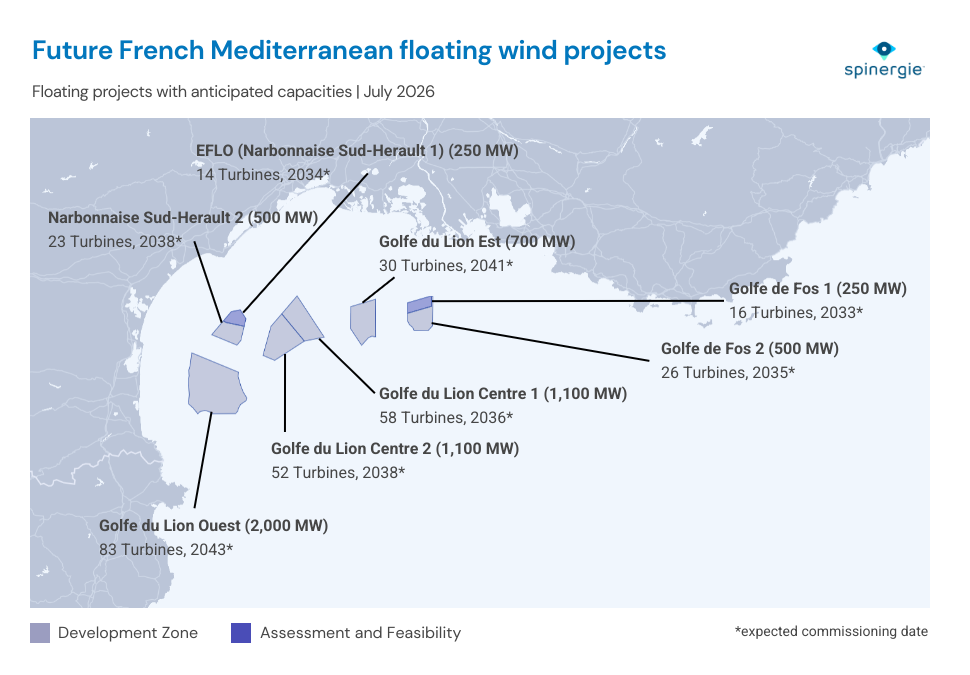
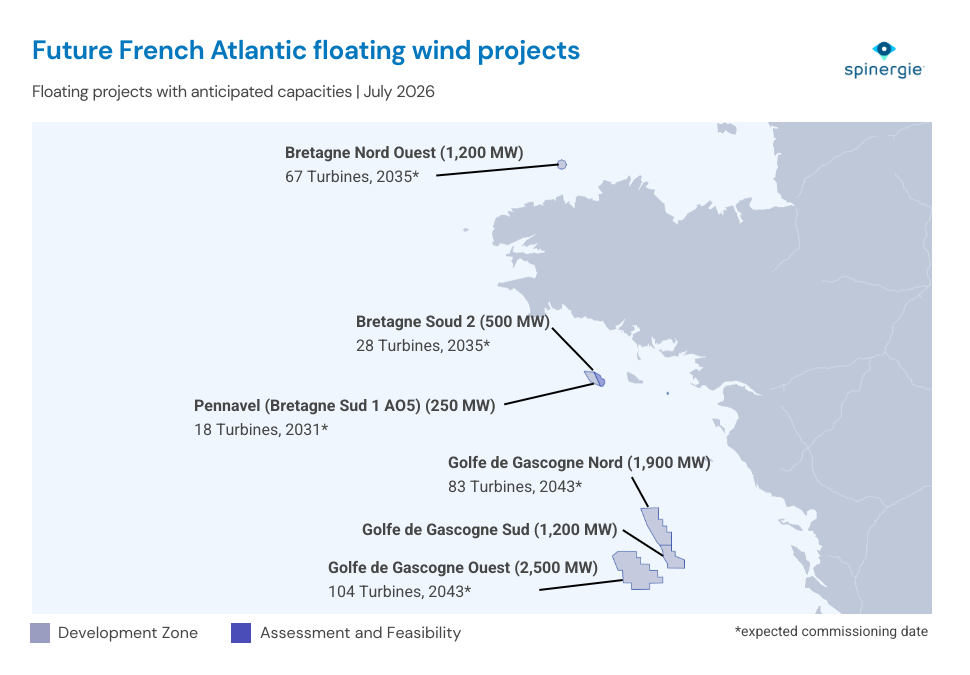
France aims to lead global floating offshore wind, with a target of nearly 6 GW of floating capacity by 2040 included in the overall 2050 offshore wind target of 45 GW. The combined AO9/AO10 tender covers about 10 GW, split roughly with 5 GW to fixed-bottom and 5 GW to floating wind. Results of this tender are expected by late 2026 or early 2027.
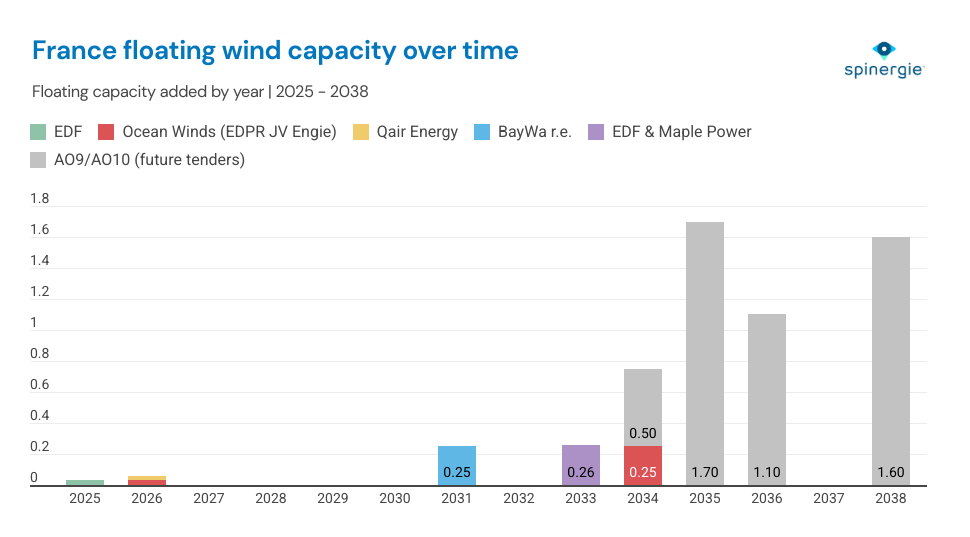
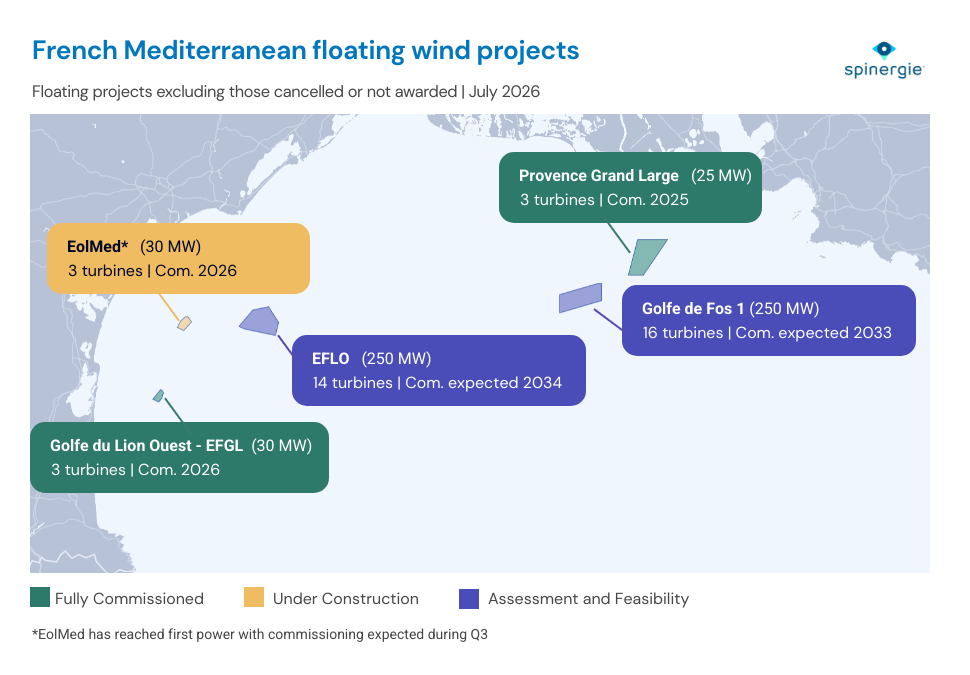
Existing floating capacity is currently limited to four Mediterranean and Atlantic pilot projects, alongside EFGL there is:
Principle Power, which held the foundation manufacturing contract, designed the semisub foundation from its Aix-en-Provence base. Eiffage (which owns Smulders group), a French construction company, carried out the outfitting and assembly scope at its Eiffage Metal yard in Fos-sur-Mer and also acted as the EPCI party for the marine works.
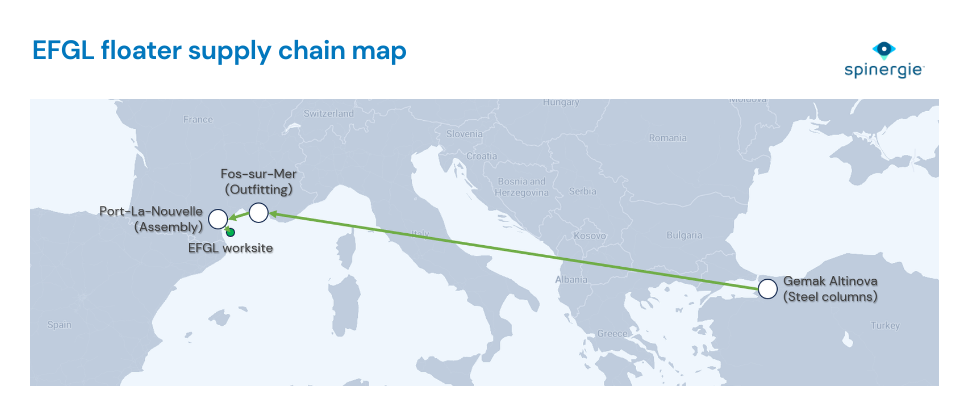
Floater fabrication was split across two countries. The three column modules of each foundation were built at the Gemak Yard, Altinova, Turkiye. Heavy load carrier Aura moved these columns from Altinova to Fos-sur-Mer between November 2023 and April 2024, with three columns on board per voyage. Eiffage Metal, in partnership with Smulders, assembled the semisub foundations at its Fos-sur-Mer yard, connecting upper and lower main beams to the column modules before outfitting and loadout.
The first foundation loaded out from Fos on 29 April 2025 with outfitting complete by July 2025. All three were towed to Port La Nouvelle for final turbine assembly.
Eiffage subcontracted the marine installation scope to Maersk Supply Service. The export and array cables scopes were handled by the JDR and DEME Offshore consortium. Cables were manufactured at JDR’s Hartlepool facility, in the United Kingdom. Vestas supplied the three V164-10 MW turbines from factories in the UK (blades) and Denmark (nacelles).
Export cable laying operations were carried out by DEME Viking Neptune with assistance from Orange Marine Sophie Germain - a telecom cable layer in a maiden offshore wind scope. These operations were carried out between April and May 2024, one year prior to installation.
Array cables were laid once foundations were in place. The flexlayer Edda Freya installed and connected the export and array cables in November 2025, finalising the installation works.
Spinergie Market Intelligence records three drag anchors (DEAs) and mooring lines in a catenary configuration in 75 m water depth.

Anchors and mooring lines were pre-laid, followed by hook-up. Mooring installation ran in the fourth quarter of 2023, ahead of foundation fabrication. Two AHTS were mobilised during the mooring campaign.
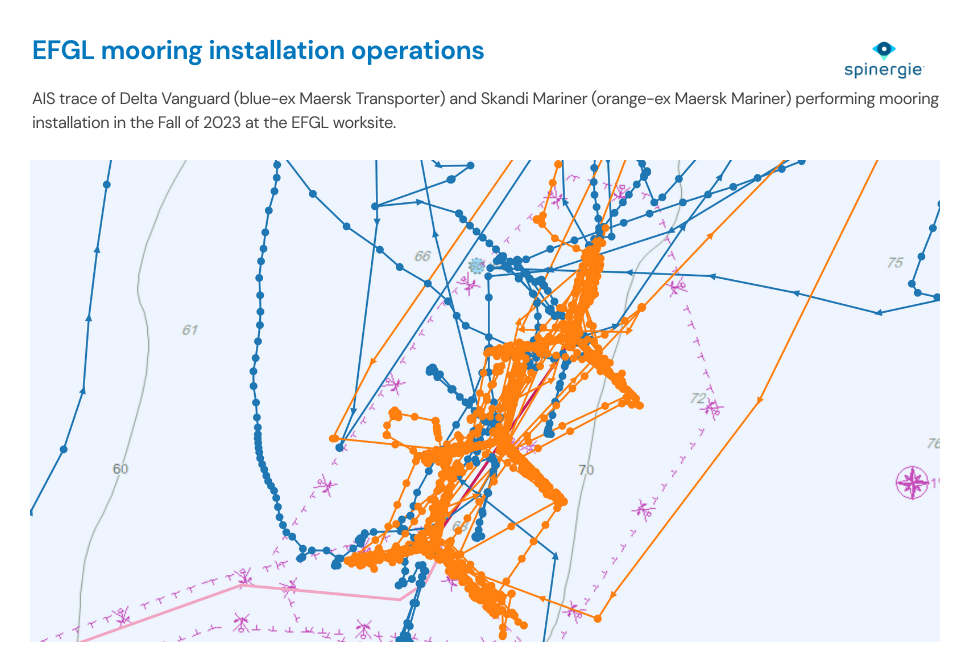
Mooring installation was undertaken roughly 18 months before tow-out decoupled seabed work from the floater installation
The three floaters were towed from Fos to Port-La-Nouvelle. They were integrated with their turbines at Quai Est 2, where the hull trim system leveled each platform during load transfer from the quay crane. The hook-up campaign then took place in the summer of 2025, after all three turbines were assembled on the quayside.
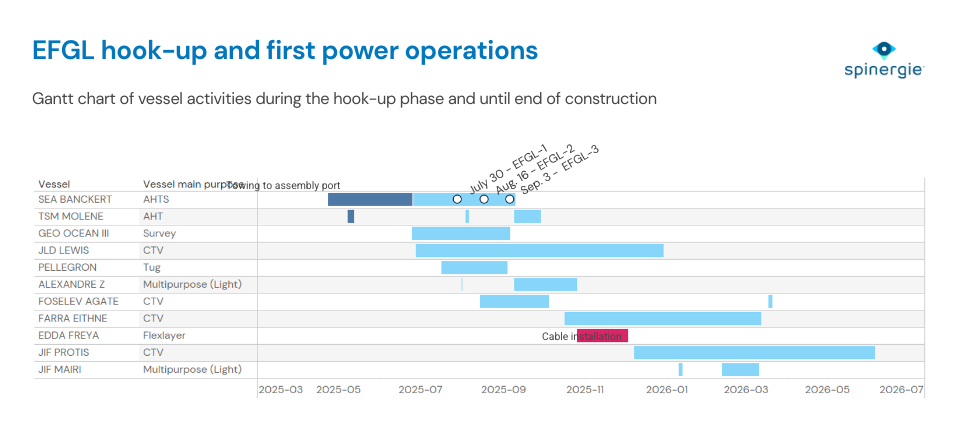
The hook-up campaign relied on Geo Ocean III, a large survey vessels used as the main hook-up asset, plus chartered anchor handlers and French regional tugs. The ex-Skandi Tender (now Sea Banckert), previously managed by DOF, was the supporting hook-up vessel. It was assisted by the tug Pellegron, which towed the units 16 km offshore to the worksite between late July and early September 2025, and performed the offshore hook-up onto the pre-installed moorings.
DeepOcean's cable-lay and flex-lay vessel Edda Freya laid the array cable from 25 October to 3 December 2025.
Offshore construction was officially completed on 8 December 2025. First power followed on 4 May 2026, leaving a five-month gap covering offshore commissioning and energisation.
Read More: Scaling up floating wind: using data from past projects to plan for the future
Spinergie Market Intelligence tracks all floating offshore wind projects from the very first auction announcement all the way through the project lifecycle from manufacturing to decommissioning. With close analysis of existing projects, you gain crucial insights that will help inform decision making and strategy in upcoming projects. Find out more about Spinergie’s Market Intelligence offering and how it can help your team with a free no-obligation demo.
Feature Image: credit Ocean Winds