
Yvan Gelbart
,
Lead Analyst
Author
, Published on
August 18, 2026
No items found.



Decommissioning an offshore wind farm: a case study of Ireland’s Arklow Bank
.png)
Arklow Bank Phase 1 was built in 2003–2004 on the Arklow Bank off County Wicklow. The project was Ireland’s first offshore wind farm and an early demonstrator for utility-scale offshore turbines. Its seven GE 3.6 MW machines, with a combined capacity of 25.2 MW, were once the most powerful offshore turbines in the world. Two decades later, its decommissioning is especially relevant: the campaign offers a rare view into how early-generation offshore wind assets are being managed as they reach end-of-life, particularly where full site clearance is not the immediate objective.
Operator GE Vernova applied to decommission the Arklow Bank Phase 1 wind farm in 2025—21 years after it was initially commissioned. The site made headlines three years prior to the decommissioning scope when one of the seven turbines caught fire after being struck by lightning, destroying the blades. This case study focuses on the blade-only removal campaign for the remaining six turbines that was executed during the summer of 2025.
The Arklow Bank decommissioning campaign took two trips from the Port of Waterford, on the Southeast coast of Ireland, to the worksite. The blades of three turbines (amounting to nine blades total) were removed during each trip. Compared to today’s commercial wind farms, Arklow Bank is situated in very shallow waters of 3 - 7 metres (10 - 23 ft), and so required a small, shallow jack-up barge for the operations.
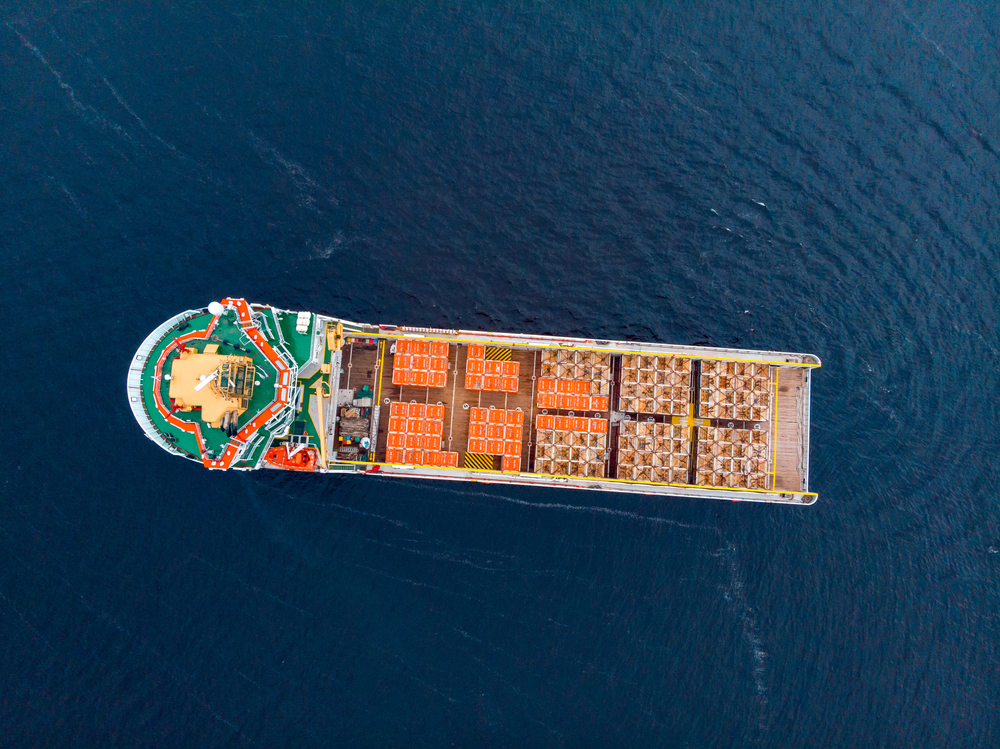
The marine spread reflects the specific constraints of Arklow Bank rather than a conventional offshore wind installation profile. Typhoon 3000 was the central asset because its small jack-up configuration matched the campaign’s shallow-water requirements: its limited draft allowed it to access the 3–7 metre worksite, while its legs provided the stability needed to carry out blade removal lifts and secure the components on its nine-blade transport rack. Sea Juliett and Mena C supported the tow, positioning, and operational logistics around the non-self-propelled barge, while AMS Panther served as the CTV bringing technicians from Arklow. Tramontane’s role was limited to harbour support at Waterford, where the blades were returned and stored.

Typhoon 3000, Mena C, and Sea Juliett each spent a month mobilised on the worksite and undertaking towing operations. The CTV, AMS Panther, was mobilised from nearby Arklow, which resulted in less time on-site and lower transit duration.


Arklow Bank differs from most offshore wind decommissioning campaigns to date such as Blyth (2019) and Vindeby (2018), because it was a blade-only intervention. This means that the towers, nacelles, monopiles and cables have been left in place.
A full removal using jack-up barge Excalibur was performed during the decommissioning of Blyth. It included the removal of turbines, the monopiles below seabed level, and 1.4 km of cable recovery. This is a clear example of decommissioning aimed towards site clearance and closure.
Meanwhile, Arklow Bank appears to be closer to a “make safe” campaign, which means removing the most failure-prone components and likely inspired by the 2022 blade fire. This objective drives the operational requirements as blade-only removal favours lighter, shallower assets, a shorter weather-window requirement, and relatively simpler logistics.

The next steps in the decommissioning of Arklow Bank Phase 1 have not yet been made public. However, the development of Arklow Bank 2—SSE’s 800 MW extension—is ongoing. This would suggest that a full-site restoration at Arklow Bank Phase 1 may not be the most operationally useful end state.
Spinergie tracks the full windfarm lifecycle from auction to decommissioning. Find out how analysis of past projects is helping our clients devise solid strategies by booking a demo today.
.jpg)
.jpg)