
Hugo Madeline
,
Senior Offshore Energy Analyst / Project Manager
Author
, Published on
August 3, 2026
No items found.



Senior Offshore Energy Analyst Hugo Madeline tracks three key Middle Eastern OSV markets to measure the impact of the 2026 Iran War and Strait of Hormuz crisis.

Offshore Support Vessel (OSV) activity in the Gulf has diverged sharply across three key energy nations (Qatar, the UAE, and Saudi Arabia) since the 2026 Iran War broke out in late February 2026.
Here, Spinergie Senior Offshore Energy Analyst, Hugo Madeline, provides a brief summary of how the OSV fleet has been impacted across all three countries.
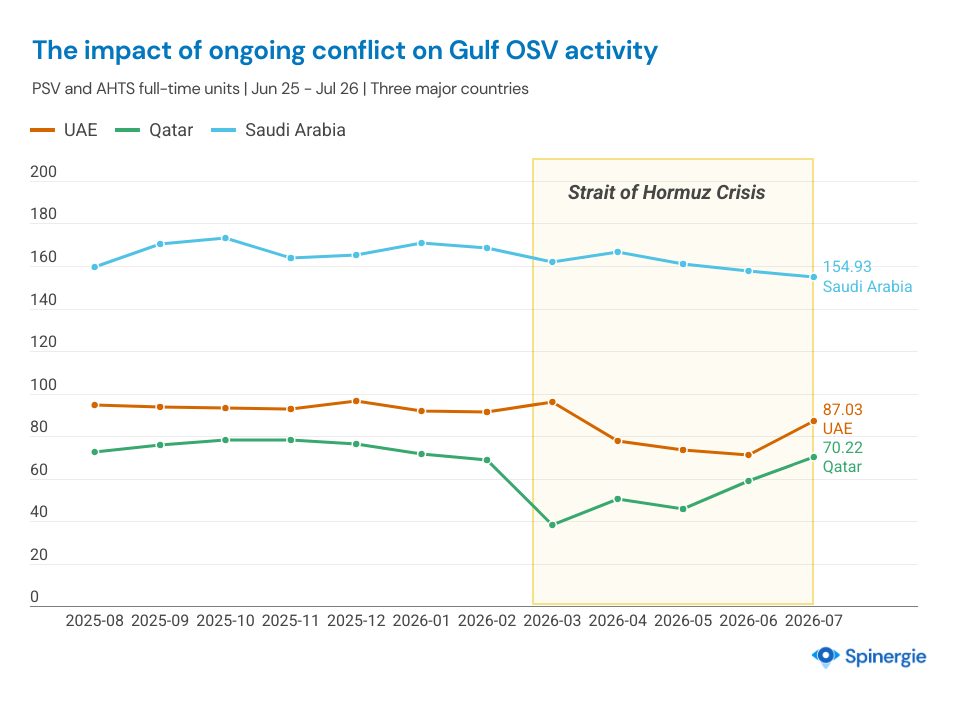
Qatar was the first to feel the full force of impact on its OSV fleet. The fleet was cut from the pre-war level of 75 vessels to 38 in March.
The collapse tracks with state-owned QatarEnergy’s force majeure declaration and the pause in offshore work following the strike on Ras Laffan.
Activity has partly recovered, with 50 vessels active by April — followed by a brief dip to 45 in May — before climbing to 58 in June. At this point activity was 23% below the pre-war baseline. However, July returned to the same pre-war levels that were recorded in January 2026.
OSV activity in the UAE initially held through the beginning of the conflict, even climbing to 96 vessels in March.
Activity began to fall in April and deepened every month until June with 71 units — a 22% drop since pre-war and a percentage decline similar to that observed in Qatar. The pattern points to contracts ending without renewal, with vessels left idle while charterers push for 25% rate cuts that owners continue to resist.
Saudi Arabia’s OSV fleet has held steady through the conflict to date, running between 157 and 168 vessels from February to June, in line with pre-war levels.
That stability follows a longer adjustment: the fleet peaked near 200 full-time units in late 2023 and early 2024. However, since then it has steadily declined as state operator Saudi Aramco’s jackup suspensions worked through the market. This decline stablised around 160 units by Spring 2026 with little visible impact from the war.
Data correct at the time of publication on August 3, 2026. This is an ongoing conflict.
Feature image: Ras Laffan Qatar Energy Port—Satellite Image
.jpg)
.jpg)