Sarah McLean
,
Lead Content Manager
Author
, Published on
August 27, 2026
No items found.



How we work with our clients to configure a noon reporting workflow that works for their business and maritime operations.
.jpg)
A noon reporting workflow is at its most effective when your crews and shore teams can both act on the same data without re-entering or reconciling it elsewhere. There’s no wading through unnecessary dashboards or reconciling data with additional platforms.
You gain further value when data from one-time entry crew reports are automatically distributed to different onshore stakeholders, allowing them to undertake their own processes without the additional step of tracking and sourcing that data.
Digital noon reporting is one of the highest value processes for a bulk or tanker operator. Done well, the same daily entry that supports fuel and voyage decisions also feeds charter agreements and the verifier-bound emissions data that informs regulatory compliance. That’s the ethos we used in building Spinergie Operations: one clean data flow instead of multiple complicated reconciliations.
Here’s what our clients tell us they really need from their vessel reporting software.
Our clients are emphatic on this: they want reporting to be simple, and they don’t want to report the same data more than once.
Today, many shipowners run multiple disconnected platforms that scatter the same underlying data across systems that don’t talk to each other. This reconciliation work may end up being the responsibility of one or a few people. Yet any single point of unavailability in such a precarious workflow increases the risk of delays and errors across the whole fleet.
Spinergie Operations works on the basis of single entry reporting where one master report gathers all manual input alongside sensor and location data. This automated noon reporting process then populates additional reports as required before dispatching them to relevant stakeholders. Single entry reporting also means crews don’t have to re-key or reconcile the same fuel and voyage figures across separate regulatory tools aimed at EU MRV, ETS, or FuelEU Maritime.
Reporting flows need to be able to handle simple corrections to departure or arrival reports without breaking the data stream. Spinergie Operations solves this by maintaining a single, clean data cycle with built-in quality checks and alerts, so errors are caught and corrected before they cascade into a verification or charterer report.
Vessel reporting standards may be uniform across the maritime sector, but when it comes to the noon report software there are variations in what each team would consider “useful”. Some prefer dashboards; some prefer at-a-glance tables, so if a reporting platform forces one view on all clients then the solution is more likely to be only half-adopted.
Ops teams want to get to what they need in a couple of clicks. However, too much change brings risk and steep learning curves to a team that doesn’t have the time to adapt. If a platform only offers one version, then some teams will have to force a new workflow that won’t work for them in the long run.
Spinergie Operations works by configuring the noon report template UX to our clients’ existing workflows. Upon adoption, our team will work with yours to refine the solution with a strong bias towards uninterrupted stability and reliability.
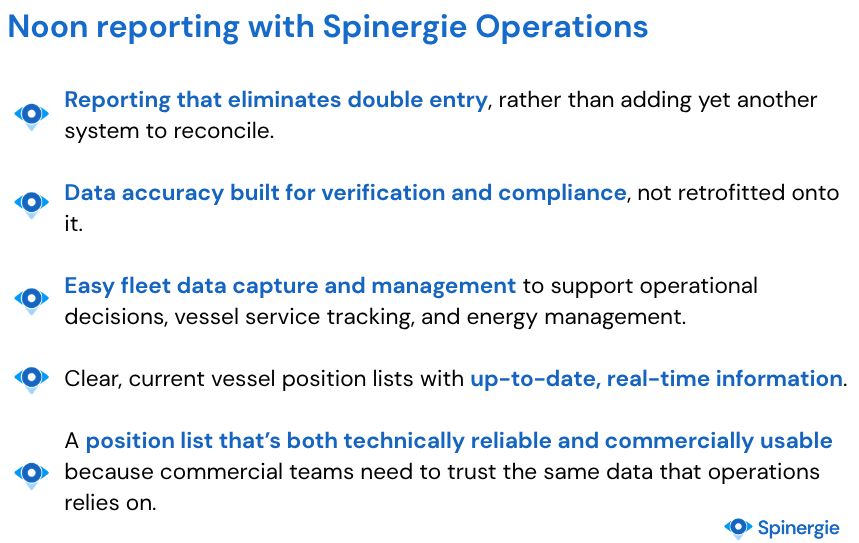
Crews aren’t filling in noon reports using stable fibre connections in an office. They’re filling in these reports from a vessel, using laptops, tablets or even mobile phones, with weak or intermittent connections. They need a platform that adapts to those working conditions. Our clients get:
CASE STUDY: See how Spinergie Operations has reduced the administrative burden for SMT Shipping’s crews
Spinergie Operations treats reporting as the backbone of fleet data management and analytics. Running from noon and voyage reports, to regulatory compliance and verification flows, crews and ops teams feed one system, not several disconnected ones.
We built our approach in the complex offshore sector which is characterised by multiple moving parts with fleets of different vessel types and specifications, all working on several projects at once. Offshore operators taught us that reporting needs to be shaped by the people using it daily and we’ve brought that philosophy into the shipping sector. We co-own the workflow with our clients, iterating its configuration on real feedback from crews and ops teams, and treating stability and usability as seriously as the data.
Ready to find out more? We’d love to meet you for a demo session tailored to your business and operational needs. Click here to book at a time that suits you.
Manually reported data (crew observations on slow steaming due to weather, engine maintenance, or cargo ops, etc.) works alongside high-frequency sensor data (RPM, shaft power, fuel flow, engine load, temperatures/pressures, navigation, etc.) and AIS (position, speed over ground, course, etc.) to provide a complete operational picture. Sensors capture the physics of what happened moment by moment, AIS provides an independent track of vessel movements, and manually reported data supplies the intent and context the others cannot provide. Spinergie Operations aligns all three into a single timeline, cross-checking one against the other, so reported figures are validated and gaps are filled.
Noon report data entered in Spinergie Operations undergoes rigorous quality checks from the point of entry, with data cleaning treated as a continuous process. Once this data is validated by a third-party verifier (Spinergie integrates with all major services), it can feed ETS and FuelEU reporting requirements directly. This removes the need to re-enter or reconcile the same figures across separate compliance platforms.
Yes, Spinergie Operations works on a one-page report structure which means all manual and automatically populated data is entered and processed once. This data then populates any custom or charter reports as required without any manual rework.
Spinergie Operations has an offline-capable reporting interface where reports are saved locally and uploaded automatically once connection is restored. Intermittent connectivity doesn’t create reporting gaps or delays.

.jpg)