

Daily reporting requirements create a heavy administrative burden for maritime fleets. This burden is exacerbated when there is a reliance on manual data entry across multiple disconnected platforms. This type of system wastes crew time and creates more opportunities for errors to slip through. Furthermore, it can be almost impossible to accurately synchronise this data between crew, superintendents, and onshore staff.
Duplicate reporting, manual QC’s and re-work have a significant negative impact on data efficiency impacting the entire workflow from crew to shore. In today’s regulatory landscape, data accuracy and synchronisation are key.
Key reporting challenges
- Fragmented data: the crew spends too much time flicking through different tabs and entering the same data for different reports.
- Cascading errors: manual data entry frequently leads to rework, which is frustrating for the crew and a major time drain for those tasked with retroactive amendments.
- Compliance pressure: clean data must be sent to verifiers well ahead of regulatory deadlines in order to avoid penalties—this can lead to a “year end scramble” to make it happen.
Operations by Spinergie
Operations by Spinergie addresses each of these reporting challenges by improving data quality, reducing time crews spend on data input, and streamlining workflows.
Reducing time spent on reporting tasks
Spinergie pre-populates several fields using fuel sensor, VMS, and GPS/AIS data. This already cuts reporting time but the administrative burden on crews is further reduced by one-time entry. The initial report is designed to your team’s specifications to ensure a smooth transition with a minimal adjustment period. Further support comes via guided entry, automatic calculations (consumption rates, delays, production rates etc.), and offline capabilities.
Quality checks from the point of entry
Errors are stopped from cascading through the system with quality checks (QCs) from the point of entry, including the blocking of any impossible readings. Input prompts ensure each field is accurate before moving onto the next—this ensures data is accurate from the start and reduces the risk of rework.
Uncomplicated compliance
Spinergie removes the “year end data scramble” from the compliance process by ensuring your data is consistently ready.
The in-built QCs ensure that all data is clean before they enter analytical and verification dashboards. With all data accessible and visible it’s quicker and easier for your team to identify and deal with any anomalies.
All your teams, whether crew or onshore, have access to Spinergie as a “central data tower”. This tower contains crew reported data—formatted per verifier requirements, and bunkering information—which is especially important when biofuels are used. These data points can be edited if necessary and errors can be corrected. This accessibility improves collaboration, reducing the need for emails or constant back and forth between different teams.
Addressing errors is simplified using the feedback loop currently available for clients using the Veracity by DNV verification service. When errors are flagged by the verifier they are linked back to the Spinergie platform which then alerts your QHSE manager so they can make the necessary corrections. This process feeds into the “central data tower” to expand the transparency between teams.
The Bottom Line: the reporting ROI
Reducing the reporting burden on crews and saving time is the most frequent challenge we hear from our clients. Feedback from Spinergie users shows that the platform has helped them make fundamental changes to their operational culture. They have moved away from fragmented data processes and towards streamlined collaboration.
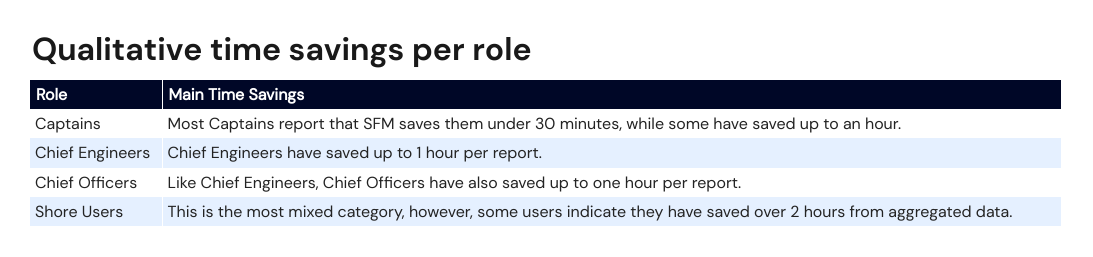
Using client feedback, we have identified qualitative time savings from Spinergie reporting. The table below highlights the time saved for each role per report.
Greater on-board efficiency
The primary feedback from Masters is that Spinergie’s one-time entry and user-friendly interface has had the biggest impact on their daily workflow. One-time entry means they no longer have to jump between multiple platforms. The intuitive interface has made reporting easier to use, faster and more convenient.
Reduced manual effort and increased collaboration
Chief Engineers also appreciated simple, quick reporting with less manual effort. Having a shared engine-deck document has allowed for improved collaboration and data consistency. They also reported that they spend less time retroactively chasing data and fixing errors.
Better transparency and heightened visibility
Shore teams found value in total fleet transparency. They now have access to centralised data—everything is kept together from voyage history to port operations. This has significantly reduced the time spent on chasing information. SFM has also improved their operational visibility, making it easier for them to monitor the full fleet and operations.
Read more: Spinergie works with SMT Shipping to improve operational and emission reporting.
Every day without automated, one-time entry accounts for at least two hours of lost time and team productivity. Find out how Operations by Spinergie can help you get your time back—get in touch today.
*Previously named Smart Fleet Management.

Our team will show you exactly how we can adapt the solution to your needs.
.jpg)